SXCOAL
Published at
Weekly: Int'l thermal coal market stays subdued amid weak demand, supply constraints
The international thermal coal market remained subdued over the past week, with weak demand and supply-side constraints weighing on prices across major exporting regions.
Indonesian export prices stayed under pressure amid soft Chinese demand and uncertainty over revisions to government production quota approvals under the RKAB scheme, prompting most miners to hold off on forward sales. Russian supply faced headwinds from rising freight costs and infrastructure bottlenecks, while Australian cargoes saw ample supply meet lackluster Asian demand. South African exports remained weak.
Demand was similarly muted. Chinese buying was largely curbed by rainfall, though a return of heatwave conditions toward the weekend lifted cooling demand and improved market sentiment. In India, the monsoon season kept power demand and import procurement subdued amid healthy plant inventories, with buying limited to higher-quality coal. European demand drew some support from winter stockpiling, but low Rhine water levels severely constrained barge transport and limited actual coal offtake.
Supply
Indonesia Indonesian thermal coal export prices remained under pressure last week, weighed by weak Chinese demand and subdued buying interest from Southeast Asia. Uncertainty over government revisions to RKAB production quotas clouded the market outlook, stalling trading activity.
Market participants said Indonesian 3,800 Kcal/kg NAR Panamax thermal coal was offered at around $65/t FOB late last week, with some deals concluded above $64/t. Freight for Panamax vessels from South Kalimantan to southern China ports stood at $8.8-9.5/t.
As of July 31, the CCI index for Indonesian 3,800 Kcal/kg NAR coal was assessed at $62.5/t FOB, flat from a week earlier but down $2/t from a month ago. The CCI index for 4,700 Kcal/kg NAR coal stood at $82.7/t FOB, unchanged week on week but $3.8/t lower than a month earlier.
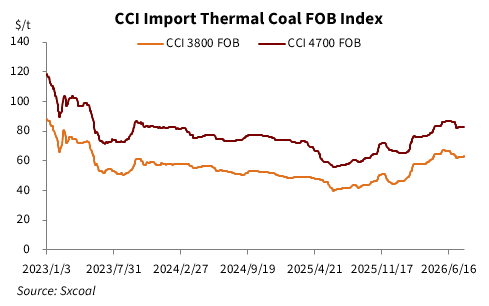
Most miners held back from forward sales due to uncertainty over RKAB quota revisions, widening the bid-offer spread. Sellers resisted price cuts on cost support, while buyers adopted a wait-and-see stance.
For most of last week, Chinese power plants largely stayed out of the spot market due to ample inventories and lower electricity consumption from rainfall, while Southeast Asian demand was insufficient to absorb available export supply. Buying interest was concentrated on low-calorific value coal, mainly from Indian buyers, while high-CV cargoes struggled to find buyers due to quality concerns and limited interest.
Toward the weekend, however, heatwave conditions in China lifted power demand and improved sentiment, raising expectations of a rebound in August imports. Miners nonetheless said they would not increase sales until quota policy clarity emerges.
Russia Russian coal export prices held relatively firm last week, supported by rising freight rates on the Russia-India route, which pushed up delivered prices.
Northeast Asian buyers remained cautious, awaiting clearer market signals in early August. Despite some hesitancy in Asian demand, Russian coal attracted increased inquiries from Indian buyers given its competitiveness in quality, pricing and transportation.
As of July 31, the CCI index for Russian 5,000 Kcal/kg NAR coal at Far East ports was assessed at $84.5/t FOB, flat week on week but down $4/t from a month earlier. The CCI index for Russian 5,500 Kcal/kg NAR coal stood at $93/t FOB, unchanged from the prior week but $4/t lower month on month.
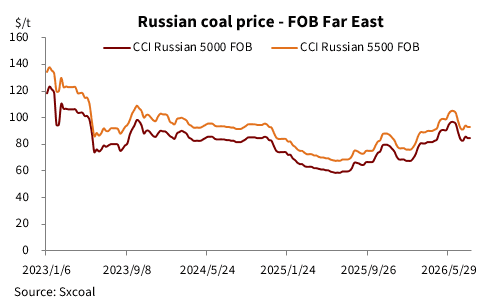
Persistently high mining costs in Russia's Kuzbass region raised expectations of some supply contraction. At northwestern and southern ports, infrastructure bottlenecks and high freight costs continued to limit loading efficiency.
Separately, the Taman port in Krasnodar Krai was hit by a drone attack in the early hours of July 30. Although the adjacent coal terminal suffered no serious damage and only brief operational restrictions, the incident heightened concerns over supply chain stability in the Black Sea region and disrupted expectations for regional coal exports.
Australia Australian thermal coal export prices remained weak last week, with subdued buying interest from major Asian importers and ample supply continuing to weigh on sentiment. As of July 31, Newcastle 5,500 Kcal/kg NAR coal prices fell below $93/t, down about $1.5/t week on week. The 6,000 Kcal/kg grade also edged lower from the previous week, dropping below $133/t.
Coal inventories across Asia remained generally ample, prompting end users to adopt conservative procurement strategies and keeping Australian prices under pressure. Chinese demand stayed weak, with buyers showing little urgency and overall trading activity limited.
While some market participants believed Australian prices were nearing a cyclical bottom, a meaningful rebound was unlikely in the near term until demand recovers visibly. In New South Wales, production and transport recovery at some mines lagged expectations following earlier rainfall, but overall supply showed no significant tightness, further capping upside for prices.
South Africa South African thermal coal prices also came under pressure last week. European gas prices retreated as geopolitical tensions eased, dragging down South African thermal coal prices. Weak demand growth and high inventory pressure at key export terminals also weighed on prices.
As of July 31, the Richards Bay 5,500 Kcal/kg NAR FOB price fell back below $89/t, down slightly from a week earlier but still marginally above the level seen a month ago. Meanwhile, the 6,000 Kcal/kg grade dropped nearly $2.5/t week on week to around $104/t FOB.
Miners generally held firm on offers, expecting demand to recover gradually rather than resorting to price cuts. However, weak overall international demand, particularly insufficient Indian buying interest, continued to slow the recovery in South African coal exports.
India, a key buyer, remained selective in its procurement. Pakistan and South Korea showed sporadic inquiries but failed to lift overall market activity. Thin spot trading and cautious buying from major consumers kept South African coal export volumes persistently low.
State-owned freight operator Transnet recently reaffirmed its target of transporting 61 million tonnes of coal along the Richards Bay coal corridor in the 2026-27 fiscal year, planning to improve transport reliability through updated maintenance schedules and continued investment in network upgrades.
Demand
China China's imported thermal coal market showed mixed performance. In the first half of last week, spot buying was limited due to ample port inventories, rainfall across many regions and typhoon-related curbs on power demand. Toward the weekend, however, the return of heatwave weather lifted daily consumption at power plants and improved sentiment, keeping prices broadly stable.
As of July 31, the CCI index for import 3,800 Kcal/kg NAR coal at China southern ports was assessed at $73.2/t CFR, flat from a week earlier. The CCI 4700 Import index stood at $92.2/t CFR, unchanged week on week, while the CCI 5500 Import index was at $113/t CFR, also flat.
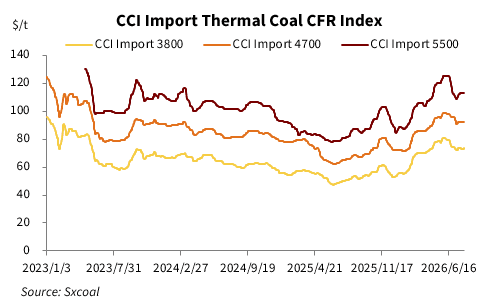
Last week, a wide bid-offer spread in the import market, combined with freight rate volatility, further dampened purchasing decisions. Toward the weekend, however, heatwave conditions intensified across eastern, central and northeastern China, significantly boosting cooling demand.
As of August 2, coal inventories at the six major coastal power groups stood at 14.37 million tonnes, down 0.44% from a week earlier. Daily consumption rose 2.17% week on week, while available stock days edged down to 15.2 days.
Domestic coal prices subsequently stabilized, with falling port inventories, tightening supply and higher transport costs bolstering seller confidence. In addition, ongoing safety inspections at some mining areas following recent accidents limited output release, providing further price support.
India India's thermal coal market remained relatively quiet under the influence of the monsoon season. Rainfall from the southwest monsoon continued to suppress power demand, reducing import procurement needs. Improved domestic coal supply and healthy plant inventories led end users to rely more on domestic sources rather than imports.
Data from India's Central Electricity Authority (CEA) showed coal inventories at Indian power plants stood at 39.22 million tonnes as of August 2, down 3.87% from a week earlier. Available stock days fell to 12.1 days, below 12.6 days the previous week. Thirty-one plants were at critically low inventory levels that day, two more than a week earlier.
Market participants showed limited enthusiasm for spot purchases, with buyers remaining cautious amid ample inventories. Growth in domestic coal output and government efforts to boost supply continued to reduce India's reliance on imported thermal coal. Nonetheless, import demand for higher-quality and branded coal from certain industries and power plants persisted, though overall procurement remained limited.
Europe European thermal coal demand showed resilience last week. Despite a pullback in natural gas prices as US-Iran tensions eased, coal futures continued to rise, reflecting solid market fundamentals. As of late last week, the CIF price for 6,000 Kcal/kg NAR coal at ARA ports edged down from a week earlier, holding just above $118/t.
Dutch TTF gas prices fell notably last week. As of July 31, the ICE TTF benchmark Dutch gas futures contract for September 2026 settled at 59.071 euros/MWh, down 7.19% from 63.649 euros/MWh a week earlier.
European power utilities continued stockpiling fuel ahead of winter, but gas storage levels remained below historical averages. LNG supply uncertainty and the possibility of tighter global gas supply continued to drive utilities to diversify fuel procurement. Meanwhile, concerns that the easing of US-Iran tensions might prove temporary kept a geopolitical risk premium in energy markets.
European coal logistics faced challenges, with Rhine and Danube river water levels falling to extremely low levels of around 30 centimeters, severely constraining barge transport capacity. Some barges halted operations or ran at only one-third capacity, pushing freight rates higher and further hampering coal shipments from ARA ports to inland power plants in Germany and elsewhere.
Source:
Other Article
Liputan 6
Published at
1,76 Juta Metrik Ton Batu Bara Disebar ke 4 PLTU Jaga Listrik di Jawa Tak Padam
Bisnis Indonesia
Published at
10 dari 190 Izin Tambang yang Dibekukan Sudah Bayar Jaminan Reklamasi
Bisnis Indonesia
Published at
10 Emiten Batu Bara dengan Laba Paling Jumbo Semester I/2026, AADI & BYAN Teratas
IDX Channel.com
Published at
10 Emiten Batu Bara Paling Cuan di 2024, Siapa Saja?
METRO
Published at