SX Coal
Published at
Weekly: Coal stocks at N China ports fluctuate downward on higher outflows
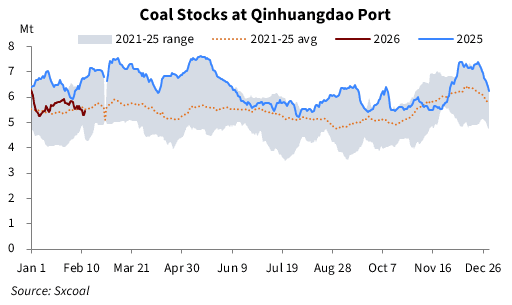
Qinhuangdao, one major coal transshipment port in northern China, saw coal stockpiles tumble further in the week ending February 13, as offtakes continued to outpace rail inflows at the port.
On February 13, coal inventories at the port dropped 3.20% from the previous week to 5.45 million tonnes, slightly increasing from the recent low of 5.30 million tonnes a day ago. That was down 3.20% from a month ago and 19.38% from the year-ago level, as per Sxcoal data.
As the Chinese New Year holiday nears, more mines in major production regions reduced or suspended production, which, paired with major state-owned mines' maintenance schedules during the break, significantly dragged down the overall spot supply.
At the same time, a lack of economics in shipping coal from production areas to northern ports dampened traders' interests in port-bound shipments, leading to a decrease in rail inflows to Qinhuangdao. The rail coal delivery averaged 395,400 tonnes each day on the line last week, down 5.82% from the week-ago level.
Facing decreased coal burns as more enterprises started holiday leaves, power plants were well fed by long-term contracted coal shipments, presenting a sluggish appetite for spot supplies. The overall offtake at Qinhuangdao port declined by 3.09% on the week, averaging 421,100 each day last week.
Meanwhile, as the cold wave weakened last week, transshipment resumed at most northern ports, including Qinhuangdao, leading to a week-on-week drop in the number of vessels anchoring at the port.
Daily average number of vessels waiting for coal loading at the port increased 3.1 from a week ago, while the ships expected to arrive jumped by 0.14 on the week, showed Sxcoal data.
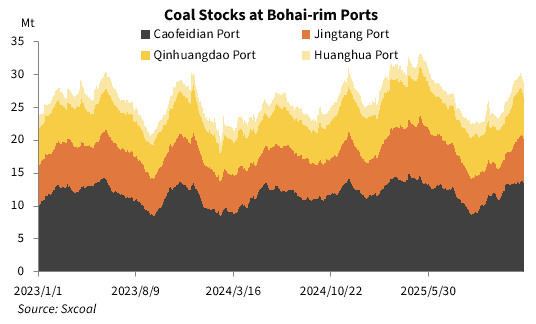
Destocking continued at the main northern ports during the week. As of February 13, the combined coal stocks of Qinhuangdao, Caofeidian, Jingtang and Huanghua ports retreated 9.44% from a week ago to 22.19 million tonnes. That was 19.46% lower than the month before and 21.14% from the year-ago level.
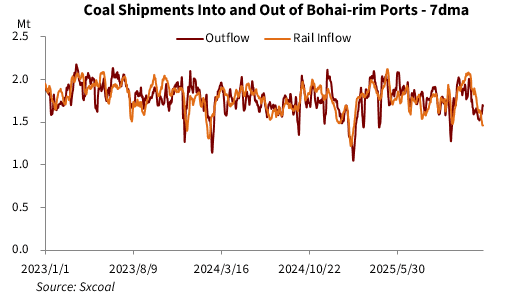
Inbound rail coal deliveries to these ports averaged 1.53 million tonnes a day last week, declining 3.93% compared to the previous week. Outflows descended 3.03% on the week to 1.56 million tonnes, according to Sxcoal data.
A total of 23 vessels were waiting for loading at these northern ports on February 13, down 89 vessels from the preceding week; 34 vessels were expected to arrive, keeping flat week on week.
The Qinhuangdao Meteorological Observatory issued an orange fog warning at 5:53 a.m. on February 13. It was forecast that over the next six hours, coastal waters and areas along the Qinhuangdao coast will be affected by dense fog, with visibility dropping below 200 meters.
As the Spring Festival holiday approaches next week, inflows and outflows at the northern ports are expected to remain subdued. Despite the eased cold snap and resumed transshipments, the upcoming foggy weather could lead to port closures, thereby affecting outflows at these ports.
Source:
Other Article
Liputan 6
Published at
1,76 Juta Metrik Ton Batu Bara Disebar ke 4 PLTU Jaga Listrik di Jawa Tak Padam
Bisnis Indonesia
Published at
10 dari 190 Izin Tambang yang Dibekukan Sudah Bayar Jaminan Reklamasi
Bisnis Indonesia
Published at
10 Emiten Batu Bara dengan Laba Paling Jumbo Semester I/2026, AADI & BYAN Teratas
IDX Channel.com
Published at
10 Emiten Batu Bara Paling Cuan di 2024, Siapa Saja?
METRO
Published at