SXCOAL
Published at
Weekly China's coastal coal freight rates plummet amid bearish pressures
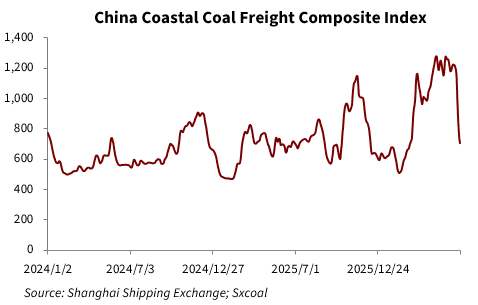
China's coastal coal freight rates plunged last week to a new low since mid-March, driven by sluggish demand and ample vessel availability.
The China Coastal Coal Freight Composite index, which tracks rates for vessels carrying coal from northern China ports to ports in the east and south, tumbled 38.03% from the week before to 708 points on June 26, according to the Shanghai Shipping Exchange. It plunged 42.92% compared to month-ago levels and declined 1.52% from a year ago.
As the middle and lower reaches of the Yangtze River entered the rainy season, persistent rainfall weighed on residential and industrial power consumption, keeping demand subdued. Weak coal burn at coastal power plants led to slight inventory build-ups due to long-term contract deliveries and imported cargo inflows.
Against this backdrop, end-user procurement cooled amid sluggish demand, resulting in sparse spot transactions. Vessel owners continued to lower freight offers, with rates declining to a three-month low.
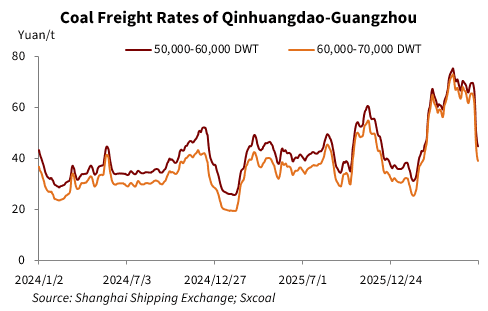
During the week, all shipping routes decreased 14.6-22.5 yuan/t compared to week-ago levels. The freight rate for the 50,000-60,000 DWT vessels carrying coal from Qinhuangdao to Guangzhou port fell 21.5 yuan/t from a week ago to 44.8 yuan/t on June 26, while that for 60,000-70,000 DWT vessels on the same route decreased 22.2 yuan/t to 39.2 yuan/t.
Internationally, the Baltic Dry Index (BDI), tracking rates for ships carrying dry bulk commodities, stood at 2,524 points on June 26, down 7.27% compared to 2,722 points a week ago.
Amid high stocks and tepid buying interest, the Asian thermal coal market remained stagnant. Panamax vessels from Indonesia to China decreased $1.30/t from the previous week to $9.19/t on June 26. Supramax freight rates on the route hit $12.42/t, down $0.62/t compared to a week earlier, while Capesize vessels from Australia to China declined $0.85/t week on week to $16.67/t.
Looking ahead, end users are expected to prioritize consuming in-plant inventories amid the ongoing rainy season across southern China, sticking to need-based procurement and optimizing calorific value inventory mixes.
Freight rates will likely face additional downside pressure on the back of weak vessel booking activity. That said, recent steep falls have capped further losses to some extent, pointing to a slower rate of decline in the near term.
Source:
Other Article
Liputan 6
Published at
1,76 Juta Metrik Ton Batu Bara Disebar ke 4 PLTU Jaga Listrik di Jawa Tak Padam
Bisnis Indonesia
Published at
10 dari 190 Izin Tambang yang Dibekukan Sudah Bayar Jaminan Reklamasi
Bisnis Indonesia
Published at
10 Emiten Batu Bara dengan Laba Paling Jumbo Semester I/2026, AADI & BYAN Teratas
IDX Channel.com
Published at
10 Emiten Batu Bara Paling Cuan di 2024, Siapa Saja?
METRO
Published at