SXCOAL
Published at
Review: India Jun coal imports fall 8.45% YoY, hit 5-yr low
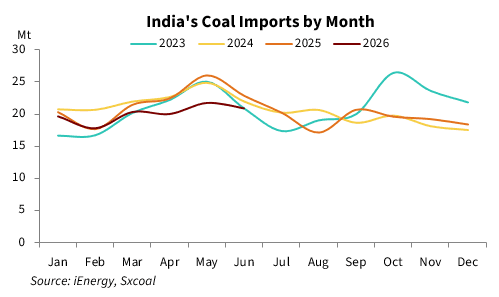
India's coal imports fell in June 2026 from a year earlier, hitting the lowest level for the month in five years, as domestic output rose and the monsoon season curbed demand.
Imports totaled 20.87 million tonnes in June, down 8.45% year on year and 3.94% from the previous month, according to data from IEnergy Natural Resources. The year-on-year decline narrowed by 7.03 percentage points from May.
The easing of geopolitical tensions, including a memorandum of understanding between the US and Iran to reopen the Strait of Hormuz, significantly reduced concerns over Middle East crude supply disruptions and pushed international oil prices lower. This indirectly lowered expectations for coal transport costs and alternative energy prices linked to energy costs.
In Asia, AI-driven investment continued to support economic growth. Despite the global economy expanding, policymakers are closely monitoring inflation, energy prices, geopolitical dynamics and trade policies, factors that could affect global economic activity in the second half of 2026.
India's domestic coal output reached 80.09 million tonnes in June, up 1% year on year and 3% month on month, driven mainly by higher production from captive and commercial coal miners. Ample overall inventories and weak coal demand due to the monsoon season weighed on consumption. Rainfall also dampened demand expectations from the construction and cement sectors.
For the first half of 2026, India's cumulative coal imports stood at 120 million tonnes, down 7.88% from 130 million tonnes in the same period last year, with the decline widening by 0.45 percentage points from the January-May period.
By coal type, non-coking coal imports totaled 13.53 million tonnes in June, down 9.28% year on year and 1.3% month on month, accounting for 64.82% of total imports, up from 62.33% in May. The decline was mainly due to a seasonal drop in power demand during the monsoon, stable domestic coal output and ample power plant inventories.
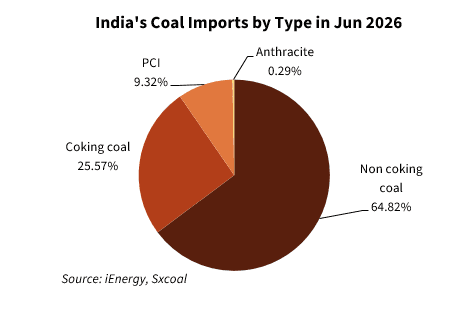
Coking coal imports stood at 5.34 million tonnes in June, down 6.07% year on year and 18.67% month on month, representing 25.57% of total imports. The decline was attributed to high base effects from concentrated steel mill procurement in the previous month, as well as increased use of metallurgical coke and PCI coal to replace some coking coal.
PCI coal imports reached 1.94 million tonnes in June, up 1.95% year on year and 38.92% month on month, signaling that steel mills continued to seek lower blast furnace costs by substituting some coke with PCI coal. Anthracite imports totaled 61,300 tonnes, down 79.26% year on year but up 3.56% month on month.
Petroleum coke imports stood at 1.08 million tonnes in June, up 34.35% year on year and 60.15% month on month. Metallurgical coke imports were 401,800 tonnes, up 17.88% year on year and 12.68% month on month.
In the first half of 2026, India's non-coking coal imports totaled 89.05 million tonnes, down 12.55% year on year. Coking coal imports reached 29.42 million tonnes, up 6.76%. PCI coal imports were 10.59 million tonnes, down 2.39%, while anthracite imports totaled 1.46 million tonnes, down 57.67%.
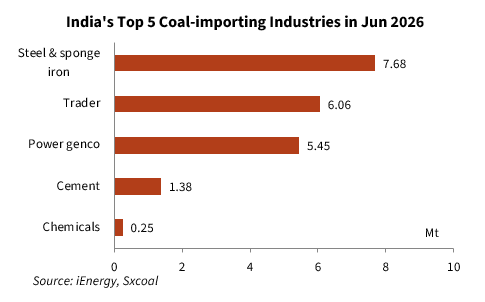
By sector, the steel and sponge iron industry imported the most coal in June at 7.68 million tonnes, down 11.49% year on year and 10.56% month on month. Supported by robust domestic demand, India's steel sector performed well in the first quarter of the fiscal year (April-June), with crude steel output reaching 42.06 million tonnes, up 3% year on year, and finished steel output rising 6%.
Output growth, steady domestic consumption and favorable demand fundamentals indicate that India's steel sector is on a solid growth trajectory despite challenges such as high import volumes and raw material price volatility.
Trader imports of coal totaled 6.06 million tonnes in June, down 16.79% year on year and 13.1% month on month.
Power sector coal imports reached 5.45 million tonnes in June, up 2.52% year on year and 41.55% month on month. In June and July, persistent El Nino conditions weakened the southwest monsoon, lowering reservoir levels and putting pressure on hydropower generation.
India's peak power demand hit a record 271 GW in May, with new highs set for four consecutive days, and June demand also exceeded the previous year's peak of 243 GW. Coal-fired power generation rose sharply by 20.7 GW in June, offsetting declines in hydropower and gas-fired capacity.
Cement sector coal imports totaled 1.38 million tonnes in June, up 40.83% year on year but down 29.03% month on month. Chemical sector coal imports were 245,500 tonnes, down 21.44% year on year but surging 2.4 times month on month. Despite the monsoon gradually slowing construction activity in some regions, India's cement market maintained solid demand.
By source country, India imported the most coal from Indonesia in June at 7.08 million tonnes, down 23.56% year on year and 0.25% month on month. Imports from Australia totaled 3.61 million tonnes, down 12.01% year on year and 20.67% month on month.
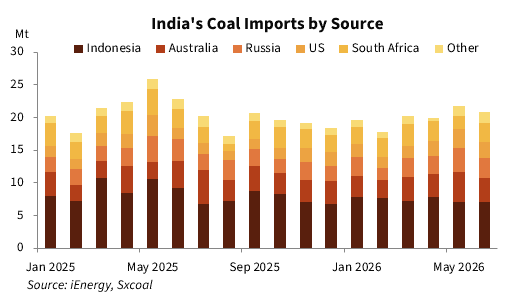
Imports from Russia stood at 3.2 million tonnes, down 3.35% year on year and 12.85% month on month. Imports from South Africa reached 2.84 million tonnes, up 1.25% year on year and surging 41.32% month on month. Imports from the US totaled 2.39 million tonnes, up 35.39% year on year but down 18.91% month on month.
After the monsoon season, typically from September onward, India's power demand is expected to rise again. With hydropower constrained by below-normal rainfall and low reservoir levels, thermal power generation may remain higher than the same period in previous years, supporting thermal coal import demand. The steel sector, benefiting from robust growth in domestic infrastructure and real estate, is expected to maintain resilient demand for coking coal and metallurgical coke.
On the international front, geopolitical developments, demand trends in China and supply policies from major exporters will also significantly influence the cost and availability of India's coal imports.
Source:
Other Article
Liputan 6
Published at
1,76 Juta Metrik Ton Batu Bara Disebar ke 4 PLTU Jaga Listrik di Jawa Tak Padam
Bisnis Indonesia
Published at
10 dari 190 Izin Tambang yang Dibekukan Sudah Bayar Jaminan Reklamasi
Bisnis Indonesia
Published at
10 Emiten Batu Bara dengan Laba Paling Jumbo Semester I/2026, AADI & BYAN Teratas
IDX Channel.com
Published at
10 Emiten Batu Bara Paling Cuan di 2024, Siapa Saja?
METRO
Published at