SXCOAL
Published at
Review: China Jun thermal power output growth slows for 3rd straight month
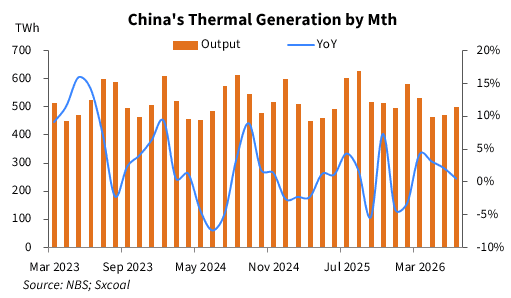
China's thermal power output growth slowed for a third consecutive month in June, as moderate temperatures and faster expansion from nuclear and solar generation weighed on coal-fired electricity.
National thermal power generation stood at 497.95 TWh in June, up 0.5% year on year, the National Bureau of Statistics data showed. The pace eased 1.6 percentage points from May and rose 5.4% from a month earlier.
Total electricity consumption rose 3.7% year on year in June, supported by industrial recovery and above-average temperatures. However, the growth rate narrowed 3.2 percentage points from May, as the impact of hot weather waned and cooling demand in coastal regions such as Guangdong had been released earlier.
China's average temperature in June was 20.7 degrees Celsius, 0.3 degrees above the long-term average, though most of the central and eastern regions saw near-normal or below-normal temperatures. The delayed arrival of widespread heatwaves and a later-than-usual end to the rainy season in the Jiangnan region pushed the peak of residential air-conditioning demand into early July, keeping June electricity consumption below expectations.
Inflows into the Three Gorges reservoir rose 22.3% year on year in June, while outflow increased 30.8%, indicating continued improvement in hydropower conditions. The trend, though moderating, further squeezed thermal power generation, alongside sustained recovery in nuclear and solar output and weaker-than-expected overall power demand.
In the first half of the year, cumulative thermal power output reached 2,028.24 TWh, up 2.9% year on year, narrowing 0.5 percentage points from the January-May pace.
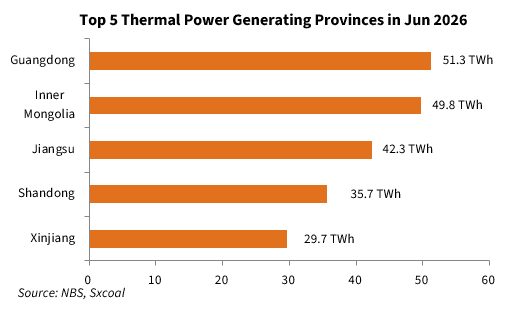
Provinces with the highest thermal power generation in June included Guangdong at 51.26 TWh, Inner Mongolia at 49.77 TWh, Jiangsu at 42.33 TWh, Shandong at 35.67 TWh and Xinjiang at 29.66 TWh. Their year-on-year changes were 19.7%, -1.6%, 2.5%, -5.8% and 4.6%, respectively.
For the January-June period, the top thermal power producers were Inner Mongolia at 276.38 TWh, Guangdong at 268.9 TWh, Jiangsu at 253.66 TWh, Shandong at 227.06 TWh, Xinjiang at 194.63 TWh and Zhejiang at 168.88 TWh, with year-on-year changes of 2.5%, 14.8%, 11.6%, 0.4%, 5% and 7.1%, respectively.
Nationally, 15 provinces and regions reported year-on-year growth in thermal power output in June, accounting for 48% of all surveyed areas. The largest gains were seen in Qinghai (55.5%), Yunnan (47.2%), Gansu (31.1%), Hainan (21%), Liaoning (20.2%) and Guangdong (19.7%).
In the first half, 16 provinces and regions posted year-on-year increases in thermal power generation, representing 51.6% of the total. The fastest growth was recorded in Tibet (35.2%), Qinghai (31.9%), Gansu (20.1%), Guangdong (14.8%), Jiangsu (11.6%) and Sichuan (9.8%).
Looking ahead, the meteorological department forecasts that most of China will see above-average temperatures in July, with only parts of eastern Inner Mongolia, northwestern part of Northeast China, southwestern part of South China and southern part of Southwest China experiencing cooler conditions. Western Inner Mongolia, northern part of Northwest China and northeastern Xinjiang could see temperatures 1-2 degrees above normal.
Precipitation is expected to be above average in eastern Inner Mongolia, Northeast China, most of North China, central-south part of Central China, central part of East China, South China, southern part of Southwest China, southwestern Xinjiang, and northwestern and southeastern Tibet. Other regions will see near-normal or below-normal rainfall.
With multiple regions reporting record power loads in July, the El Nino weather pattern is expected to sustain hot conditions. High temperatures and reduced rainfall, combined with strong demand during the peak summer season, are set to support thermal power output. Tighter supply-demand dynamics could also fuel expectations of a new round of electricity price increases.
Source:
Other Article
Liputan 6
Published at
1,76 Juta Metrik Ton Batu Bara Disebar ke 4 PLTU Jaga Listrik di Jawa Tak Padam
Bisnis Indonesia
Published at
10 dari 190 Izin Tambang yang Dibekukan Sudah Bayar Jaminan Reklamasi
Bisnis Indonesia
Published at
10 Emiten Batu Bara dengan Laba Paling Jumbo Semester I/2026, AADI & BYAN Teratas
IDX Channel.com
Published at
10 Emiten Batu Bara Paling Cuan di 2024, Siapa Saja?
METRO
Published at