SX Coal
Published at
Review: China Jul thermal power generation posts 1st YoY decline in 2026
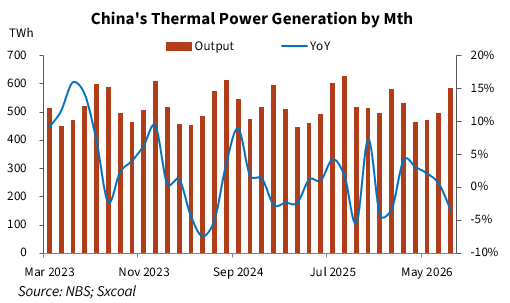
China's overall power generation largely stabilized in July 2026, but thermal power contribution recorded its first year-on-year (YoY) decline of the year, as robust hydropower output during the flood season and expanding clean energy capacity squeezed thermal power's share.
China's thermal power generation totaled 584.1 TWh in July, down 3.5% YoY, reversing a 0.5% increase in June, according to the latest data released by the National Bureau of Statistics (NBS).
China's total electricity consumption reached 1,040 TWh in July, up 1.7% YoY, with growth slowing by 2 percentage points from the previous month, according to the National Energy Administration.
The national average temperature in July was 23.5 degrees Celsius, 1.3 degrees Celsius above the seasonal norm and the second-highest on record for the month, the National Meteorological Center noted.
While electricity demand kept climbing alongside higher temperatures, coal-fired power generation failed to gain traction amid the ongoing transformation of the domestic power mix.
Heavy rainfall across southwestern and southern China during the main flood season boosted hydropower generation. National average precipitation reached 123.0 mm in July, 1.1% above the historical norm of 121.7 mm, official data showed. In July, average water inflows at the Three Gorges reservoir rose 1.95% from June, directly translating into higher hydro output.
Meanwhile, wind power generation returned to a YoY increase in July, while nuclear and solar output both rose over 5.5% despite slower growth rates. The expansion of clean energy sources created a clear substitution effect on thermal power.
Cumulative thermal power generation over January-July reached 3,612.7 TWh, up 1.8% year on year, NBS data showed, with the growth narrowing by 1.1 percentage points from the first half.
In Jul, Inner Mongolia, Jiangsu, Guangdong, Shandong and Zhejiang were the top five thermal power producers in China, reaching 58.43 TWh (-0.7% YoY), 50.20 TWh (-2.3% YoY), 49.70 TWh (-4.7% YoY), 42.76 TWh (-7.7% YoY) and 37.61 TWh (6.6% YoY), respectively.
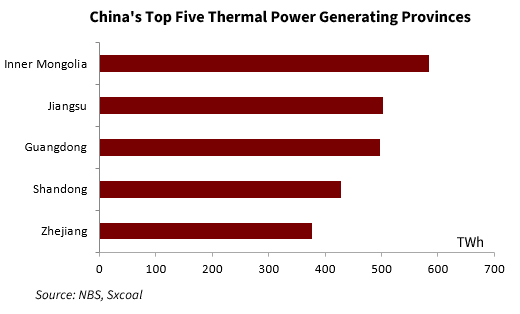
In the first seven months, Guangdong topped cumulative thermal generation at 246.71 TWh (10.5% YoY), followed by Inner Mongolia at 238.79 TWh (0.7% YoY), Jiangsu at 222.08 TWh (10.0% YoY), Shandong at 188.99 TWh (0.1% YoY), Xinjiang at 149.45 TWh (1.4% YoY) and Shanxi at 137.21 TWh (-2.0% YoY).
Twenty provinces and regions, or 65% of the national total, recorded YoY declines in thermal power output in July. The sharpest drops were in Hunan (-21.5% YoY), Hubei (-19.7% YoY), Henan (-16.7% YoY), Jilin (-13.1% YoY), Yunnan (-10.3% YoY) and Guangxi (-9.9% YoY).
Over January-July, 14 provinces and regions, or 45% of the total, saw thermal generation fall YoY, led by Chongqing (-23.5% YoY), Hunan (-17.3% YoY), Hubei (-11.3% YoY) and Shaanxi (-6.5% YoY).
Meteorological forecasts indicate most of China will see above-normal temperatures in August 2026, with parts of Inner Mongolia, Beijing, Shanxi, Shandong, northern Jiangsu, northern Anhui, Henan, central-western Hubei, north-central Sichuan, Chongqing, Xizang, Qinghai, Gansu, Ningxia, Shaanxi and Xinjiang expected to be 1-2 degrees Celsius warmer than usual.
Precipitation is forecast to be above normal in northeast China, eastern North China, most of East China, southern Central China, South China, southern Southwest China, western Xizang and western Xinjiang, while other regions will be drier than normal. Two to three typhoons are expected to make landfall or significantly affect China in August, near the historical average.
Looking ahead, the strengthening El Nino climate pattern is expected to bring broader and more intense heat, pushing August power loads to a record high. Combined with robust electricity consumption during the summer peak, thermal power's role in ensuring grid supply will become more prominent.
Thermal output is likely to improve from a month earlier, though whether it returns to YoY growth will depend on hydropower conditions.
Source:
Other Article
Liputan 6
Published at
1,76 Juta Metrik Ton Batu Bara Disebar ke 4 PLTU Jaga Listrik di Jawa Tak Padam
Bisnis Indonesia
Published at
10 dari 190 Izin Tambang yang Dibekukan Sudah Bayar Jaminan Reklamasi
Bisnis Indonesia
Published at
10 Emiten Batu Bara dengan Laba Paling Jumbo Semester I/2026, AADI & BYAN Teratas
IDX Channel.com
Published at
10 Emiten Batu Bara Paling Cuan di 2024, Siapa Saja?
METRO
Published at