SX Coal
Published at
Monthly: China Sep thermal coal stay firm, supply tightness persists
China's domestic thermal coal prices remained firm in September 2026, with supply tightness unchanged amid stringent safety inspections and port-bound shipment losses, while demand performed well.
August supply-demand summary
Supply Total thermal coal supply in August 2026 was 321.98 million tonnes, up 7.29% from the previous month. Cumulative effective supply for January-August 2026 was 2.67 billion tonnes, down 3.20% year on year.
Demand Total thermal coal consumption in August 2026 was 371.92 million tonnes, up 2.01% month on month. Cumulative consumption for January-August 2026 was 2.78 billion tonnes, up 1.13% from the same period last year.
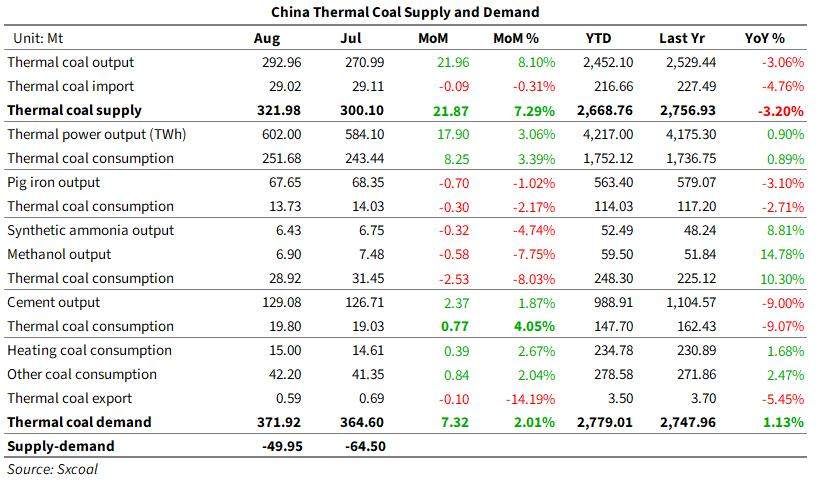
Overall, thermal coal demand exceeded supply by 49.95 million tonnes in August 2026.
Production areas
Thermal coal prices in producing areas fluctuated slightly in September but remained firm overall. Despite ongoing mine resumption, supply tightness persisted under strict safety inspections. Demand was supported by rigid procurement from end users with low inventories and pre-holiday restocking. Mine sales were smooth, and prices continued to rise even after the supply guarantee policy was introduced, though some end users turned cautious.
With some previously suspended mines in Shanxi and Shaanxi resuming operations, capacity utilization improved, though some mines halted production for underground maintenance or after completing monthly output targets. Overall capacity utilization remained at a low level. The stable production and supply guarantee policy will take time to implement, and a significant supply increase is unlikely in the near term. Sxcoal's survey data showed that as of September 23, average weekly output for the month was 16.12 million tonnes, up 4.24% from the previous month but down 2.73% year on year.
As mines resumed operations and coal prices rose rapidly, chemical and other end users reduced procurement on a wait-and-see basis. After the stable production and supply policy was introduced, market观望 sentiment intensified, coal truck traffic at mines declined, and inventories increased, with some mines hitting storage capacity. As of September 23, thermal coal inventories at surveyed mines stood at 4 million tonnes, up 5.4% month on month but down 3.36% year on year.
As of September 24, the mine-mouth price of Datong 5,500 Kcal/kg NAR coal in Shanxi was 855 yuan/t, up 129 yuan/t from the previous month. Ordos 5,500 Kcal/kg NAR coal in Inner Mongolia was priced at 822 yuan/t, up 134 yuan/t month on month. Yulin 5,800 Kcal/kg NAR coal in Shaanxi was at 897 yuan/t, up 137 yuan/t from the previous month.

Transfer ports
Inventories at transit ports accumulated in September. Safety inspections in main producing areas remained stringent. Although mines that had been widely suspended gradually resumed, the pace was slow and supply constraints persisted. However, as port prices rose rapidly, traders became more active in shipping, and improved railway capacity helped inbound volumes recover. On the outbound side, some power plants had restocking demand after summer consumption drew inventories to low levels. With the dual holidays approaching and the Daqin line scheduled for autumn maintenance after the National Day holiday, some users restocked ahead of the holiday, boosting outbound volumes. But as pre-holiday restocking ended, high outbound levels were hard to sustain. Overall, inbound slightly exceeded outbound, and inventories accumulated modestly after falling to low levels.
As of September 28, total inventories at the four northern ports stood at 24.07 million tonnes, up 25,000 tonnes or 0.001% from the previous month and up 0.06% year on year. Qinhuangdao port held 6.25 million tonnes, up 140,000 tonnes or 2.29% month on month and up 14.05% from a year earlier.

With the dual holidays approaching, end users had some restocking demand. Meanwhile, non-power end users entered the traditional "Golden September" peak season, with operations recovering and driving up coal demand, diverting port inventories. In addition, power plants focused on fulfilling long-term contracts, with stable evacuation rhythms steadily drawing down port stocks. However, rapidly rising coal prices at northern ports curbed power plant procurement demand. Indonesia's RKAB remained unclear, and drought on Indonesia's main inland rivers affected shipments, limiting both domestic and imported coal replenishment to varying degrees. As a result, Guangzhou port inventories fell to low levels and fluctuated there. As of September 23, Guangzhou port held 2.6 million tonnes, down 19.7% from the previous month but up 6.7% year on year.
Persistent supply tightness combined with high shipment costs, amid decent demand, kept traders' willingness to hold prices firm, pushing coal prices higher. However, the introduction of the supply guarantee policy cooled the market, with gains gradually narrowing and even signs of a pullback.
As of September 24, the CCI index for domestic 5,500 Kcal/kg NAR coal at Qinhuangdao port was assessed at 991 yuan/t, FOB with VAT, up 102 yuan/t or 11.47% from the previous month and up 40.37% year on year.

As of September 24, the ex-stock price of Shanxi premium blend (S 0.6) 5,500 Kcal/kg NAR thermal coal at Guangzhou port was 1,030 yuan/t, up 75 yuan/t or 7.85% from the end of the previous month. Temperatures in southern China remained relatively high during the month, and with support from the northern port market, prices maintained their upward trend.
Import market
Imported coal tracked domestic coal trends in September. Tight domestic supply and periodic restocking by end users drove domestic coal prices higher. Imported coal followed suit, with Indonesia facing tight supply due to RKAB issues and drought on major inland rivers. Combined with post-monsoon restocking in India and winter stockpiling demand in Europe, the international market was well supported. As coal prices rose to high levels, downstream acceptance was limited. Meanwhile, China's stable production and supply policy slowed downstream procurement, and imported coal prices were adjusted downward.
As of September 24, the CCI index for import 5,500 Kcal/kg NAR coal at Guangzhou port was assessed at $129.0/t CFR, the CCI 4700 Import index at $109.0/t CFR, and the CCI 3800 Import index at $88.0/t CFR, up $10.5/t, $10.0/t and $9.0/t respectively from the previous month.

Consumption areas
Entering September, as high temperatures gradually receded across the country, coastal power plant operations declined overall. But high temperatures persisted in southern China and other areas, and the "Golden September and Silver October" industrial order peak season boosted industrial power use. Combined with weak hydropower and insufficient renewable output, daily consumption in southern China remained at high levels, even matching previous peaks.
As of September 28, inventories at the six major coastal power groups stood at 14.23 million tonnes, up 137,000 tonnes or 0.97% from the end of the previous month and up 2.94% from a year earlier. Daily consumption was 878,000 tonnes, down 70,000 tonnes or 7.38% from the end of the previous month but up 1.62% year on year. Available days stood at 16.2, up 1.3 days from the end of the previous month and up 0.2 days from a year earlier.

September highlights
As coal prices rose, the urgency of supply guarantees came to the fore again. On September 7, the National Development and Reform Commission said it led multiple departments in holding a special meeting that set three goals — stabilizing output, strengthening transport capacity and expanding outbound shipments — to upgrade Xinjiang into a core strategic support base for national coal supply.
On September 18, the NDRC, the National Energy Administration and the National Mine Safety Administration jointly issued a notice outlining measures to accelerate stable production and supply guarantees for coal. Eight requirements were put forward: attaching great importance to safe and stable coal production and supply, fully carrying out monitoring, scheduling and production organization, actively and steadily advancing the resumption and full production of suspended mines, optimizing and improving coal production policies, properly handling mines exceeding approved capacity on a case-by-case basis, strictly enforcing medium- and long-term thermal coal contract signing and fulfillment, effectively leveraging imports as a supplementary adjustment, and advancing coal capacity succession.
Shanxi, where supply tightness is most acute, also deployed coal supply guarantees. On September 13, the Shanxi Provincial Energy Bureau held a meeting on thermal coal supply guarantees, vowing to fully ensure stable thermal coal supply. On September 18, it issued a notice on conducting safety assessments for stable coal mine production and supply. On September 26, it held another meeting on safe and stable coal production and supply, requiring that under the premise of strictly adhering to safety bottom lines, full efforts be made to advance work resumption and stable production, and to accelerate reversing the output decline trend.
Safety-related work continued. The release of the new implementation measures for coal mine enterprise safety production licenses further standardized safety production conditions for coal mines from various aspects, aiming to further regulate safety conditions and strengthen license issuance management.
Ordos city in Inner Mongolia issued an emergency notice targeting overproduction, explicitly requiring severe crackdowns to uphold coal mine safety bottom lines. In cases of major hidden dangers from overproduction, mines must strictly implement suspension and rectification orders and promptly eliminate hazards. For mines engaged in overproduction, alongside suspension and rectification orders, administrative penalties, accountability measures and public exposure will be comprehensively applied under a "zero tolerance" approach.
On September 4, multiple departments in Shanxi held a consultation meeting on standardizing coal mine safety production administrative law enforcement, further consolidating regulatory enforcement synergy and promoting quality and efficiency improvements in coal mine safety enforcement across the province. On September 23, the Standing Committee of the Shanxi Provincial Party Committee held a meeting to study and deploy key work for the Mid-Autumn and National Day holidays, requiring unrelenting efforts in safety production, highlighting pre-emptive prevention and deepening special rectification of coal mine safety risks. On September 22, Hunan province held the 100th executive meeting of the provincial government to study and deploy special plans including coal mine safety production, and in principle approved the overall plan for classified disposal of coal mines in Hunan.
Additionally, on September 16, the completion and navigation of the Pinglu Canal opened a new channel for coal transport in southwestern China, covering both domestic and imported coal. With the new "sea-to-river" route, imported coal and coal shipped from north to south can be unloaded at Beibu Gulf ports such as Qinzhou port and directly enter Guangxi's inland waterways via the Pinglu Canal, reaching Nanning, Guigang and other areas in the middle and upper reaches of the Xijiang River without detouring through Guangzhou port in the Pearl River Delta. This reduces costs and improves supply security.
Each month, Sxcoal's analyst team conducts a comprehensive analysis of China's thermal coal market from the perspectives of supply/demand, import/export, stock, and price trends. The monthly report also includes insights on the latest coal policies, key events, and forecasts for thermal coal prices for the upcoming month and the remainder of the year.
Source:
Other Article
Liputan 6
Published at
1,76 Juta Metrik Ton Batu Bara Disebar ke 4 PLTU Jaga Listrik di Jawa Tak Padam
Bisnis Indonesia
Published at
10 dari 190 Izin Tambang yang Dibekukan Sudah Bayar Jaminan Reklamasi
Bisnis Indonesia
Published at
10 Emiten Batu Bara dengan Laba Paling Jumbo Semester I/2026, AADI & BYAN Teratas
IDX Channel.com
Published at
10 Emiten Batu Bara Paling Cuan di 2024, Siapa Saja?
METRO
Published at