SX Coal
Published at
Indonesian coal exports keep declining despite Middle East conflict
Escalating tensions between Iran, the U.S. and Israel emerged as a key source of volatility in global energy markets in recent weeks. Yet despite heightened geopolitical risks, the conflict had limited impact on coal shipments from Indonesia, the world's largest coal exporter.
Shipping routes used for coal trade largely bypass the Strait of Hormuz since the outbreak of the conflict, and Indonesia's main export destinations in Asia remained accessible.
In addition, Middle Eastern countries are not major hubs in global coal trade flows, meaning tensions around the strategic waterway have not directly disrupted Indonesian shipments.
However, shipping data showed that Indonesia's seaborne coal exports fell sharply over the past week, declining significantly not only compared with the week before the conflict escalated but also relative to levels seen a month earlier and in the same period last year.
According to vessel-tracking data from Kpler, Indonesia's seaborne coal exports totaled 7.08 million tonnes in the week ending March 8, down 25.82% from the previous week. The volume was also 19.18% lower than a month earlier and 25.66% below the same period last year.
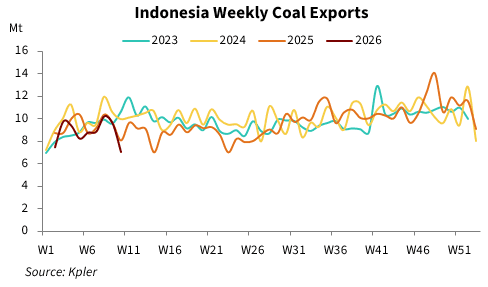
Shipments of Indonesian coal to China reached 2.55 million tonnes, falling nearly 30% week on week, the data showed.
While the Middle East conflict appears to have coincided with weaker exports, Indonesia's declining shipments have largely been driven by domestic developments.
Since the beginning of the year, export volumes have been weighed down by uncertainty surrounding export duty policies and slow approvals of 2026 Work Plan and Budget (RKAB).
Data from Kpler showed that Indonesia's weekly seaborne coal exports in 2026 mostly remained below year-earlier levels, typically ranging between 8 million and 9 million tonnes per week, compared with more than 10 million tonnes on average in the fourth quarter of 2025. Only one week in mid-February exceeded the 10-million-tonne mark, and even that was below the same period a year earlier.
Indonesia tightened production quotas this year, signaling deliberate efforts to control output and support prices. Some mining companies reportedly cut production by 40-70%, while national coal output in January plunged nearly 30% year on year. Exports during the month fell 22.73% from December.
Against this backdrop, the recent Middle East conflict appears to have acted more as a market amplifier rather than the root cause of the export slowdown.
Higher oil prices, rising freight rates and stronger energy substitution demand pushed up seaborne coal prices, significantly increasing import costs. As the price advantage of Indonesian coal narrows, or even reverses, buyers in key markets such as China and India became more cautious, with some shifting toward domestic supply or alternative sources.
That shift could benefit other exporters, particularly Australia. Economists estimated that disruptions in global oil and gas supply are prompting utilities to turn to coal, driving prices up by 20% to 25% in recent weeks and potentially boosting Australia's coal export revenue by A$5 billion or so.
Shipping data also supported this view. While Australia's seaborne coal exports declined slightly last week, forecasts suggested shipments will increase in the coming weeks, with exports to China also expected to gradually recover.
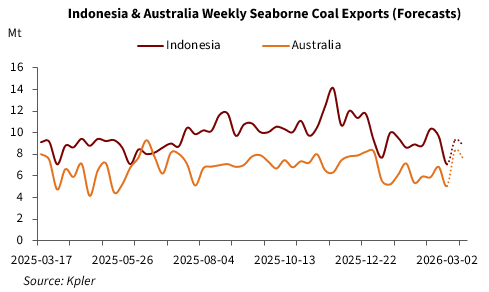
However, sharply rising prices in exporting regions such as Australia and South Africa may also limit actual trading activity.
An Indonesian coal producer said that despite the strong rally in Australian and South African coal prices, demand for Indonesian coal has not increased significantly.
On the demand side, seaborne coal arrivals in Japan, South Korea and several Southeast Asian countries remained relatively stable last week, though vessel data suggested imports could rise noticeably in the coming weeks.
In Europe, coal imports showed a steady upward trend in recent weeks, though projections suggest shipments may ease again in the near term.
For Indonesia, coal production and shipments are also expected to remain subdued during the Ramadan period. At the same time, policy uncertainty over production quotas and domestic supply obligations persists.
With Indonesian miners showing limited appetite to ramp up output and some holding back cargoes in anticipation of higher prices, competing exporters are moving quickly to fill the supply gap.
Overall, the decline in Indonesian exports is primarily driven by domestic policy decisions, while the Middle East conflict mainly added another layer of uncertainty to global coal markets by pushing up oil prices, freight costs and substitution demand.
Source:
Other Article
Liputan 6
Published at
1,76 Juta Metrik Ton Batu Bara Disebar ke 4 PLTU Jaga Listrik di Jawa Tak Padam
Bisnis Indonesia
Published at
10 dari 190 Izin Tambang yang Dibekukan Sudah Bayar Jaminan Reklamasi
Bisnis Indonesia
Published at
10 Emiten Batu Bara dengan Laba Paling Jumbo Semester I/2026, AADI & BYAN Teratas
IDX Channel.com
Published at
10 Emiten Batu Bara Paling Cuan di 2024, Siapa Saja?
METRO
Published at