SX Coal
Published at
India's Feb coal imports fall 8.51% MoM led by power sector decline
India's coal imports saw a notable month-on-month decline in February 2026, primarily driven by reduced purchases from the power sector. But the volume remained slightly above year-ago levels amid sustained demand from cement and chemical industries.
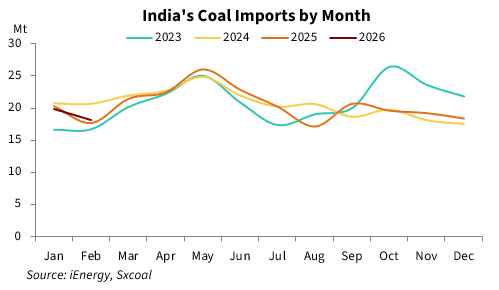
The country imported 18.10 million tonnes of coal in February, up 2.36% year on year (YoY) yet down 8.51% month on month (MoM), according to data from iEnergy.
Over the past month, the global coal market exhibited divergent trends against the backdrop of ongoing geopolitical tensions in the Middle East. Shipping disruptions through the Strait of Hormuz pushed international oil prices above $100 per barrel, reigniting energy-driven inflationary pressures.
Expectations of the U.S. interest rate cuts were delayed, intensifying the U.S. dollar. European natural gas storage levels fell behind seasonal averages, underscoring the region's energy vulnerability. Russia, in contrast, benefited from higher energy prices.
As the world's second-largest coal importer, India is heavily dependent on external energy resources. Surging global oil prices directly elevated the nation's import costs and inflation risks, with the rupee depreciating to a historical low against the U.S. dollar, further intensifying inflationary pressures.
Domestically, India's coal output maintained a YoY growth since the beginning of this year, partially curbing import needs. India produced 208.5 million tonnes of coal over January-February, up 2.8% YoY.
Cumulative coal imports stood at 37.88 million tonnes during the first two months, dipping 0.22% from 37.96 million tonnes in the same period last year.
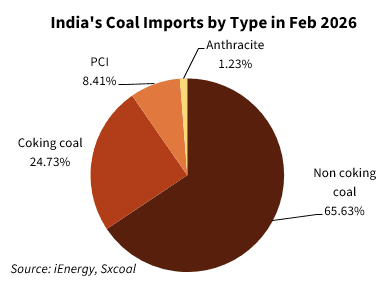
In breakdown by type, the South Asian nation imported 11.88 million tonnes of non-coking coal in February, down 0.23% YoY and 5.92% MoM, while anthracite imports declined by 18.07% YoY and 27.41% MoM to 222,500 tonnes.
Thermal coal import demand weakened again in February following a brief peak earlier in the year, due to fewer working days and relatively subdued demand. Meanwhile, constrained export supplies from Indonesia and higher international thermal coal prices also played a part.
Imports of coking coal reached 4.47 million tonnes during the month, up 17.29% YoY yet diving 9.43% MoM. Buying activity from Indian buyers moderated, mainly due to fewer working days and slightly increased coking coal prices. Backed by lower imports and rising exports, India's steel output continued steady expansion, creating more room for domestic coal production growth.
Imports of PCI coal totaled 1.52 million tonnes, sliding 18.07% YoY and 27.41% MoM, primarily due to a high base in both the year-ago and month-ago levels.
India imported 619,500 tonnes of met coke in February, surging 113.63% YoY and 16.82% MoM, while petroleum coke imports slumped 58.77% YoY and 31.28% MoM to 606,100 tonnes, as sustained premiums of petroleum coke over thermal coal prompted cement producers to shift toward thermal coal usage.
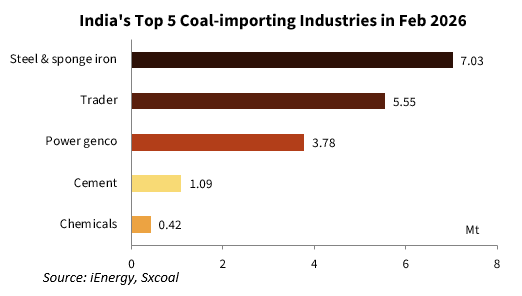
India's steel and sponge iron industries imported most coal in February, hitting 7.03 million tonnes, falling 2.96% YoY and 10.55% MoM, as per iEnergy data.
As growing demand and supply risks reshape global trade patterns, India is actively stepping up efforts to secure supplies of key raw materials for steelmaking.
The Indian government is planning consultations with countries including Argentina, Indonesia and Oman, aiming to enhance access to critical raw materials such as coking coal, iron ore and other minerals. With India's deepening reliance on imports, particularly for materials like coking coal and ferronickel, diversifying supply sources is becoming increasingly important.
In February, India's power sector imported 3.78 million tonnes of coal, retreating 25.33% YoY and 11.55% MoM. India's power demand hit a 15-year high of about 133 TWh last month, up 2% YoY. This was mainly driven by higher-than-normal temperatures in multiple regions, which boosted cooling demand and elevated electricity consumption.
The cement sector imported 1.09 million tonnes, surging 107.47% YoY yet diving 14.4% MoM; and the chemical industry received 417,200 tonnes, jumping 85.14% YoY and 17.67% MoM.
By origin, Indonesia remained India's largest coal supplier in February, shipping 7.70 million tonnes, up 7.46% YoY yet down 0.88% MoM. South African coal arrivals gained 13.91% YoY and 18.44% MoM to 2.95 million tonnes.
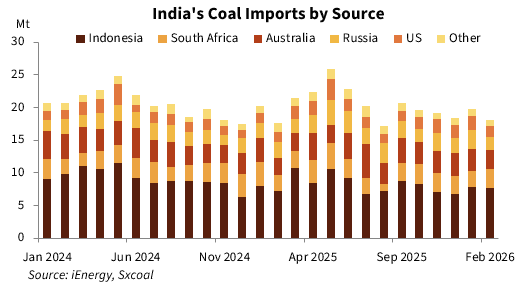
Imports from Australia rose 15.36% YoY yet declined 14.75% MoM to 2.91 million tonnes, and Russian coal imports fell 18.24% YoY and 33.07% MoM to 1.96 million tonnes. Coal intakes from the U.S. gained 4.78% YoY but declined 18.55% MoM to 1.68 million tonnes.
Looking ahead, India's coal imports face multiple constraints. High international oil prices and rising freight rates are expected to lift arrival costs. Should premiums of petroleum coke over thermal coal persist, it would further suppress petroleum coke imports and encourage cement producers to use more thermal coal as a substitute. Nevertheless, the Indian government is actively engaging with other nations in pursuit of diversified supply sources to secure steelmaking raw materials.
The nation's power demand is anticipated to extend rises approaching the peak summer season. iEnergy projects annual power demand growth of 1-1.5%. Coking coal and metallurgical coke imports are likely to keep rising along with steel capacity expansion, though price volatility and trade policy changes such as anti-dumping duties could introduce uncertainty.
In the near term, international geopolitical developments, Indonesia's supply policies, and domestic infrastructure demand in India will be key variables determining import trends.
Source:
Other Article
Liputan 6
Published at
1,76 Juta Metrik Ton Batu Bara Disebar ke 4 PLTU Jaga Listrik di Jawa Tak Padam
Bisnis Indonesia
Published at
10 dari 190 Izin Tambang yang Dibekukan Sudah Bayar Jaminan Reklamasi
Bisnis Indonesia
Published at
10 Emiten Batu Bara dengan Laba Paling Jumbo Semester I/2026, AADI & BYAN Teratas
IDX Channel.com
Published at
10 Emiten Batu Bara Paling Cuan di 2024, Siapa Saja?
METRO
Published at