SX Coal
Published at
China's Jan-Feb raw coal output hits 2nd record high despite cut expectation
China's raw coal output hovered high in the first two months of 2026, instead of shifting down as some market participants had anticipated, according to the latest data released by the National Bureau of Statistics (NBS).
The output amounted to 762.89 million tonnes, slipping 0.3% from the year-ago level, yet still hitting the second-highest level for the same period in history, only second to 2025, the NBS data showed.
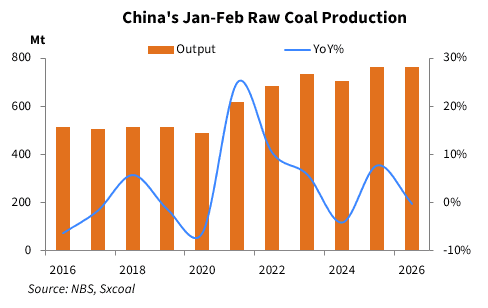
Daily raw coal output averaged at 12.93 million tonnes over January-February, dropping 8.30% or 1.17 million tonnes from 14.10 million tonnes in December and falling 0.31% or 40,000 tonnes from 12.97 million tonnes in the same months last year.
The production resilience, despite the holiday impact and safety inspections, may be linked to both domestic and international factors.
First, China's coal production has been setting new records for several consecutive years, rising at an average rate of 1.8% annually since surpassing 4.5 billion tonnes in 2022, which laid the foundation for maintaining high output.
Second, the country's policy to ensure energy supply still echoed. Despite a shift of the government's call from increasing output to stabilizing production, key mining hubs have largely maintained high output and shipments, which is unlikely to see significant reductions in the short term.
Third, demand remained robust. In January-February, China's power generation rose by 4.1% year on year, with output from coal-fired units gaining 3.3% on the year, offering floor support to raw coal production.
Finally, the escalating geopolitical conflicts have provided a stimulus to domestic production. Amid soaring prices and tightening supplies, energy self-sufficiency has become a key priority, which has, to a certain extent, prompted greater attention to domestic energy supply.
Additionally, since imported coal has lost its price edge, some end users opted to source coal from domestic providers, offering additional support. As the trend is expected to continue, miners remained highly motivated to ramp up production, further supporting output stability.
Despite the high output in the first two months, industry insiders still expect the whole-year production to slow down, driven by overproduction inspections, the government's measures to scale back cut-throat competitions and the gradually peaking coal demand.
In major coal production regions, including Shanxi, Shaanxi, Inner Mongolia, Xinjiang and Guizhou, which accounted for 85% of China's raw coal production, coal output plans in 2026 have seen only marginal decreases.
Shanxi aims to stabilize production at around 1.3 billion tonnes in 2026, slightly down from 1.31 billion tonnes in 2025. Inner Mongolia targets over 1.25 billion tonnes this year, compared with 1.29 billion tonnes a year before.
Although Shaanxi has not announced the 2026 target, it has revealed plans to promote coal production to ensure energy supply. Its output was 805 million tonnes in 2025, and is expected to stay around 800 million tonnes in 2026, with a slight increase possible.
Xinjiang's production is projected to remain stable with a minor jump from 553 million tonnes in 2025, while Guizhou sets a goal of 190 million tonnes in 2026, higher than 150 million tonnes a year ago.
Based on targets outlined above, China's raw coal output is highly likely to drop in 2026, though the scale remains to be seen, and may hinge on future movements in the global energy market.
Source:
Other Article
Liputan 6
Published at
1,76 Juta Metrik Ton Batu Bara Disebar ke 4 PLTU Jaga Listrik di Jawa Tak Padam
Bisnis Indonesia
Published at
10 dari 190 Izin Tambang yang Dibekukan Sudah Bayar Jaminan Reklamasi
Bisnis Indonesia
Published at
10 Emiten Batu Bara dengan Laba Paling Jumbo Semester I/2026, AADI & BYAN Teratas
IDX Channel.com
Published at
10 Emiten Batu Bara Paling Cuan di 2024, Siapa Saja?
METRO
Published at