SXCOAL
Published at
Asia thermal coal imports rise both 9% YoY and MoM in Jun on mixed factors
Asian seaborne thermal coal imports rose both year on year and month on month in June, as bullish and bearish factors played out across the region.
On the one hand, milder-than-usual rainfall across key North Asian consuming countries at the start of summer significantly curbed cooling demand, weighing on prompt thermal coal consumption.
On the other, risks of escalating geopolitical conflicts, structural supply disruptions and firm demand from some countries provided price floor support and even upward momentum. While prices edged higher mid-month before retreating, market anxiety over the approaching peak summer heat and winter restocking has not fully dissipated.
Asian seaborne thermal coal imports reached 72.22 million tonnes in June, showed Kpler vessel-tracking data, up 9% year on year and 1.38% from the previous month. January-June cumulative imports totaled 414 million tonnes, down 1.92% from a year earlier.
China's seaborne thermal coal imports rebounded sharply both year on year and month on month in June, becoming the main driver of regional growth. Imports stood at 26.36 million tonnes, up 33.51% from a year earlier and 19.1% from the previous month. January-June cumulative imports were 133 million tonnes, down 7.33% year on year.
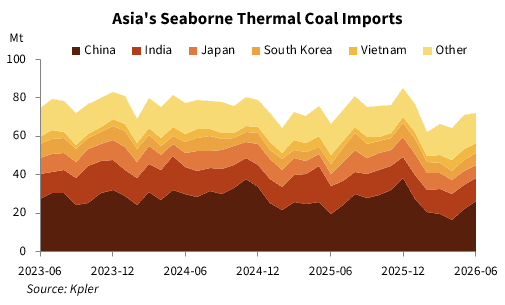
Kpler noted that June marked the early stage of China's summer peak power demand season, but relatively mild weather and heavy rainfall kept coal consumption low. Coal-fired power plant inventories in parts of southern China continued to build, which could curb import demand later.
From June to early July, persistent heavy rain hit southern China, with Typhoon Maysak bringing downpours to Guangxi, Guangdong and Yunnan. The rain lowered temperatures, reducing air conditioning demand, and significantly boosted hydropower output. The moderating effect on hot weather also curbed power demand to some extent.
However, Kpler said the risk of a return to high temperatures later in the season remains. Once the rainy season ends and summer heat returns, pent-up power demand could quickly lift coal consumption, potentially forcing Chinese importers to chase higher prices.
India experienced its driest June in 12 years due to a delayed southwest monsoon, with coal-fired power generation surging 13% year on year. Despite the dry weather and lower domestic coal output, demand failed to pick up, largely due to resilient domestic coal production and high inventories at both power plants and mines, prompting end-users to prioritize domestic coal.
Kpler data showed India's seaborne thermal coal imports at 11.77 million tonnes in June, down 18.59% year on year and 7.44% from the previous month. January-June cumulative imports totaled 74.82 million tonnes, down 14.22% year on year.
More critically, changes in the price spread between international thermal coal and petroleum coke led Indian buyers to significantly increase US coal purchases in June as a substitute for petroleum coke, while imports from traditional thermal coal sources such as Indonesia and South Africa remained sluggish. India's sponge iron sector, a major consumer of South African coal, has sharply increased its blending ratio of domestic coal, pushing South African exports to India to a three-year low in June.
Japan's seaborne thermal coal imports totaled 6.97 million tonnes in June, up 12.9% year on year but down 3.48% from the previous month. South Korea's imports reached 6.26 million tonnes, up 17.27% year on year and 15.66% month on month.
South Korea has emerged as a key driver of thermal coal demand growth this year, supported by lower nuclear power availability and cost pressures from volatile LNG prices. January-June seaborne thermal coal imports rose 24.89% year on year to 35.81 million tonnes.
In contrast, Japan's import growth lagged behind South Korea. Japan's long-term LNG supply contracts give it more flexibility, reducing the need for gas-to-coal switching. Meanwhile, Japan's nuclear power generation efficiency is expected to recover by late summer, which could curb coal consumption growth even as cooling demand rises.
Southeast Asian thermal coal import growth was relatively subdued in June. Vietnam's seaborne thermal coal imports stood at 4.93 million tonnes, up 7.81% year on year but down 14.49% from the previous month. The Philippines imported 2.39 million tonnes, up 3.1% year on year and 0.26% month on month. Malaysia's imports totaled 2.75 million tonnes, down 22.93% year on year and 12.53% month on month.
On the pricing front, the seaborne thermal coal market followed a "rise-then-fall" trajectory in June. Prices initially rallied early in the month but gave back most of the gains by month-end, with the monthly average price at the ARA ports stabilizing in the mid-$120/t range.
The direct driver of the price decline was the cool and rainy weather across the northern hemisphere, which cut real-time coal consumption in the power sector. However, prices did not collapse, with core support coming from market concerns over supply-side uncertainties and geopolitical risks. If negotiations break down completely, an escalation of geopolitical conflicts would directly push up natural gas prices, and coal prices, as a power generation fuel, typically move in tandem with gas prices in the short term.
Source:
Other Article
Liputan 6
Published at
1,76 Juta Metrik Ton Batu Bara Disebar ke 4 PLTU Jaga Listrik di Jawa Tak Padam
Bisnis Indonesia
Published at
10 dari 190 Izin Tambang yang Dibekukan Sudah Bayar Jaminan Reklamasi
Bisnis Indonesia
Published at
10 Emiten Batu Bara dengan Laba Paling Jumbo Semester I/2026, AADI & BYAN Teratas
IDX Channel.com
Published at
10 Emiten Batu Bara Paling Cuan di 2024, Siapa Saja?
METRO
Published at