SXCOAL
Published at
Asia seaborne thermal coal imports rise 2.4% YoY in Jul
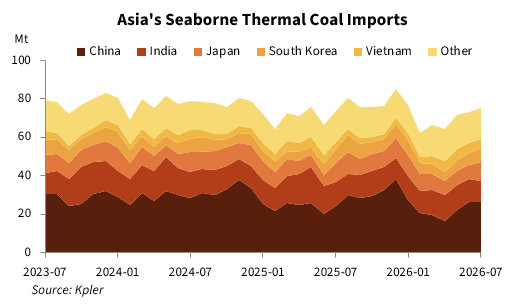
Asia's seaborne thermal coal imports totaled 75.51 million tonnes in July, up 2.38% year on year and 3.55% from the previous month, according to Kpler vessel tracking data.
January-July imports reached 490 million tonnes, down 1.21% year on year.
China's seaborne thermal coal imports continued to recover in July but remained below year-earlier levels on a cumulative basis. Imports stood at 26.13 million tonnes, up 6.93% year on year but down 1.64% month on month. January-July imports totaled 159 million tonnes, down 5.29% year on year.
As the El Nino phenomenon transitions to La Nina, rainfall in southern China has exceeded expectations. Abundant precipitation has weakened high temperatures and reduced cooling power demand, while boosting hydropower output in provinces such as Yunnan. Power transmitted via west-to-east corridors has met incremental demand in coastal regions including Guangdong, squeezing coal-fired power generation.
Despite steady economic activity and positive growth in total electricity consumption, coal-fired unit utilization hours were suppressed in June, curbing coastal power plants' appetite for imported coal and slowing inventory drawdowns.
Since late July, coal consumption for power generation in southern China has risen steadily while domestic output has not kept pace, keeping the supply-demand balance tight and supporting import volumes. Kpler expects imports to remain firm in August and September if the consumption trend continues.
India's thermal coal market, by contrast, is in a clear destocking phase, with July imports falling for a fourth consecutive month to a year-to-date low. Imports totaled 11.36 million tonnes, down 6.76% year on year and 5.11% month on month. January-July imports reached 86.83 million tonnes, down 12.94% year on year.
The decline does not reflect weak end-user demand. India's coal-fired power generation rose 13% year on year to 114.7 TWh in July, a record for the month, as the government relied on higher domestic mine output to meet surging electricity demand. Domestic coal production rose 7.5% year on year in July, the fastest pace in 11 months.
Power plant and mine inventories have been heavily drawn down in the process. Coal stocks at Indian power plants fell to around 37 million tonnes by early August from a high of 54 million tonnes in March, with days of cover dropping to warning levels. The rapid inventory drawdown, while temporarily curbing import demand, may prove unsustainable.
With inventory buffers weakening and industrial activity and power demand expected to recover after the monsoon season, the likelihood of Indian buyers returning to the seaborne market is rising sharply. Market expectations point to a new restocking cycle beginning in the fourth quarter of 2026.
Japan's seaborne thermal coal imports totaled 9.48 million tonnes in July, down 4.55% year on year but up 33.9% month on month. South Korea's imports stood at 7.60 million tonnes, down 0.21% year on year and up 18.53% month on month.
Coal-fired power demand in Japan is rising on higher electricity needs and a gas-to-coal switching trend. However, relatively mild local weather in June and recovering nuclear output limited the scope for import growth in July.
South Korean buyers' gas-to-coal switching has similarly supported overall import demand. But with imports now exceeding year-earlier levels, buyers have begun to slow purchasing to digest accumulated inventories. Unless extreme heatwaves similar to 2025 occur in August, South Korea's second-half imports will likely fall below 2025 levels.
Southeast Asian thermal coal import demand showed strong resilience in July, with Vietnam a standout performer. Vietnam's seaborne thermal coal imports reached 4.62 million tonnes, up 28.06% year on year but down 5.39% month on month. The Philippines imported 3.25 million tonnes, up 9.92% year on year and down 5.36% month on month. Malaysia's imports totaled 3.10 million tonnes, down 1.42% year on year and up 11.18% month on month.
Vietnam's sourcing patterns are shifting. As Indonesia tightens export controls to support domestic prices and competition from Japan and South Korea for Australian high-CV coal intensifies, Vietnamese buyers are turning to Russian coal as an alternative. Imports from Russia surged 166% year on year in July to a record high.
Global thermal coal prices showed divergence and rangebound trading between June and August. A concentrated release of Chinese demand in late summer or early autumn could push prices toward or above the upper end of the range.
Meanwhile, the spread between European prices (ARA ports, CFR) and Australia's Newcastle FOB has been influenced by both Black Sea events and low Rhine River water levels. While gas-to-coal switching economics have improved due to gas shortages, the sharp drop in Rhine water levels has severely hampered coal transport from ports to inland German power plants, decoupling actual European coal demand from price signals and limiting upside for ARA port prices.
Overall, Asia's thermal coal market in summer 2026 is in a tug-of-war between "strong expectations" and "weak reality". China's purchasing pause due to weather and inventory factors, import corrections in Japan and South Korea, and India's active destocking have jointly suppressed short-term demand.
However, structural supply tightening, persistent Black Sea geopolitical risks disrupting Russian coal exports, shrinking Chinese domestic output year on year, and India's inventories near lows are building momentum for a rebound. Once demand-side support returns, supply-demand mismatches could quickly push prices higher, with a notable upward trend likely in the second half, particularly in the fourth quarter.
Source:
Other Article
Liputan 6
Published at
1,76 Juta Metrik Ton Batu Bara Disebar ke 4 PLTU Jaga Listrik di Jawa Tak Padam
Bisnis Indonesia
Published at
10 dari 190 Izin Tambang yang Dibekukan Sudah Bayar Jaminan Reklamasi
Bisnis Indonesia
Published at
10 Emiten Batu Bara dengan Laba Paling Jumbo Semester I/2026, AADI & BYAN Teratas
IDX Channel.com
Published at
10 Emiten Batu Bara Paling Cuan di 2024, Siapa Saja?
METRO
Published at