SXCOAL
Tayang pada
Weekly: Int'l thermal coal prices show mixed moves on supply, demand shifts
International thermal coal markets saw stronger supporting factors over the past week, with sentiment improving from the previous week, though price performance varied across regions. European markets came under pressure as geopolitical risk premiums faded and natural gas prices weakened, while South African prices moved narrowly amid subdued Indian demand during the monsoon season.
In contrast, the Chinese market emerged as a key driver of Asia-Pacific sentiment, supported by tight domestic supply and rising demand from hot weather. Indonesian supply remained constrained by uncertainty over production quotas and domestic market obligations, keeping prices firm. Australian high-CV coal prices faced pressure from weak Asian buying interest, though demand for lower-CV grades remained relatively stable. Overall, global thermal coal supply and demand remain in a state of negotiation.
Supply side
Indonesia Indonesian thermal coal supply disruptions persisted over the past week, mainly due to continued uncertainty over 2026 revised work plans and budgets (RKAB) production quotas, supporting miners' willingness to hold prices firm. Indonesian thermal coal prices edged up.
According to market participants, Indonesian 3,800 Kcal/kg NAR Panamax thermal coal was offered at around $67-67.5/t FOB as of late last week, with some transactions concluded at around $66/t. Panamax freight from South Kalimantan to southern China ports stood at around $9.5/t.
As of August 7, the CCI index for Indonesian 3,800 Kcal/kg NAR coal was assessed at $65/t FOB, up $2.5/t from the previous week and $1.7/t from the same period last month. The CCI index for 4,700 Kcal/kg NAR coal was assessed at $84.8/t FOB, up $2.1/t week on week but down $0.2/t from a month earlier.
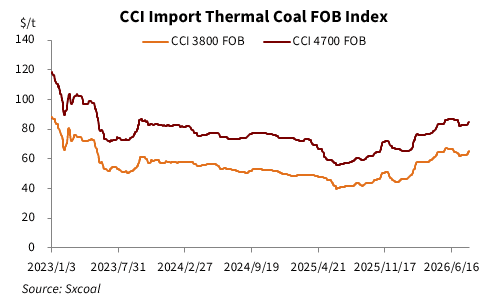
According to market sources, some Indonesian miners have received notices of updated quota allocations, but the scale of adjustments and specific beneficiary companies have yet to be confirmed, leaving the market without clear direction. Some miners reported that quota adjustments may come with higher output, but at least half of any increase must be directed to state utility PLN, further limiting exportable volumes, particularly for higher-CV grades.
Meanwhile, low water levels on rivers in East and Central Kalimantan are hampering barge movements, with logistics bottlenecks exacerbating tight spot supply. Although buying from China and India has slowed, Southeast Asian buyers such as Vietnam and the Philippines remain actively inquiring and accepting current premiums for mid-to-high CV coal, providing underlying support for Indonesian prices.
Russia Russian high-CV thermal coal prices at Far East ports fell slightly last week, while prices at northwestern ports rose by $0.5-1.2/t and southern port prices declined.
As of August 7, the CCI index for Russian 5,000 Kcal/kg NAR coal at Far East ports was assessed at $87/t FOB, up $2.5/t from the previous week and $3.5/t from a month earlier. The CCI index for Russian 5,500 Kcal/kg NAR coal was assessed at $95/t FOB, up $2/t week on week and $3/t from the same period last month.
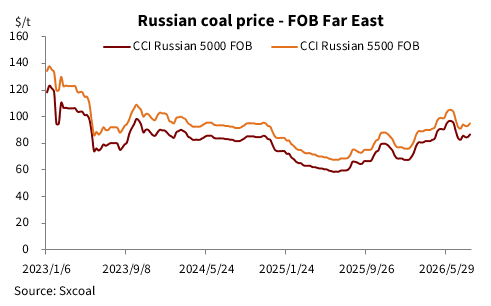
Although coal terminals are operating normally, vessel movements in the Black Sea face disruptions, with rising insurance costs prompting some shipping companies to stop accepting new bookings to the region. Combined with Turkish restrictions on vessels heading to Novorossiysk port, customs clearance and berth arrangements have been further delayed, significantly extending shipping schedules.
Against this backdrop, Russian sellers attempted to raise offers, pushing prices to multi-year highs at one point, but buyers showed limited acceptance of higher prices, widening the bid-offer gap. As buying interest waned later in the week, actual transaction prices pulled back. Some suppliers were forced to shift marketing focus to other Asian buyers, though demand across Northeast Asia remained cautious, with purchases mainly targeting forward cargoes for autumn delivery.
Australia Australian thermal coal export prices came under pressure over the past week due to weak buying interest from major Asian buyers, with high-CV prices seeing more notable declines. Chinese and Indian buyers remained on the sidelines at current price levels, with purchasing interest focused on forward cargoes rather than prompt spot supplies.
As of August 7, Newcastle 5,500 Kcal/kg NAR thermal coal prices edged back above $93/t, up around $1/t week on week. The 6,000 Kcal/kg NAR price fell notably from the previous week to just above $128/t, a decline of more than $4/t.
Although cold snaps lifted coal-fired power generation in Australia's domestic electricity market, this factor failed to transmit to the export side, with export prices diverging clearly from domestic demand trends. On the supply side, market rumors suggest some previously idled mines are gradually resuming shipments. Port inventories remain at relatively reasonable levels, with no significant congestion or supply disruptions, keeping overall supply stable.
On the demand side, buying activity in Northeast Asia, including Japan and South Korea, has not accelerated, with purchases mainly fulfilling long-term contract obligations and limited spot inquiries. Indian buyers remained on the sidelines due to ample domestic inventories and weak monsoon-season demand. Some market participants noted that Australian coal prices are currently less competitive compared with other sources, making it difficult to stimulate additional spot demand.
South Africa The South African thermal coal market moved within a narrow range over the past week, with suppliers maintaining firm pricing strategies despite weak Indian demand during the monsoon season.
As of August 7, South Africa's Richards Bay 5,500 Kcal/kg NAR thermal coal FOB price remained below $89/t, down slightly from the previous week. Meanwhile, the 6,000 Kcal/kg NAR FOB price recovered to above $105/t, up more than $1/t week on week.
Although Indian end-users were largely absent from the market due to weak domestic steel prices and losses in the direct reduced iron (DRI) sector, some DRI plants reliant on seaborne coal shifted to domestic coal purchases or made sporadic replenishment from spot traders to hedge currency fluctuation risks. Overall import appetite remained subdued.
Meanwhile, rising diesel prices squeezed profit margins and increased operating costs for South African miners, who were unwilling to lower offers, leaving buyers and sellers in a standoff. Some suppliers have shifted marketing focus to other Asian buyers including South Korea, Vietnam and Pakistan to diversify away from weak Indian demand.
Richards Bay Coal Terminal inventories remained at reasonable levels, and the annual 10-day maintenance that ended on August 1 has allowed loading operations to return to normal. Industry participants generally expect Indian demand to gradually recover after the monsoon ends in September, when the DRI sector is expected to resume purchases. Some traders have already begun preparing for post-monsoon restocking, with several forward cargo deals concluded recently.
Demand side
China China's imported thermal coal market remained subdued for most of last week, with buyers limiting spot purchases due to ample port inventories, persistent rainfall and typhoon-related restrictions on power demand. Toward the weekend, sentiment improved as heatwave conditions intensified, lifting cooling-driven power demand and raising daily coal consumption at power plants.
As of August 7, the CCI index for import 3,800 Kcal/kg NAR coal at China southern ports was assessed at $76/t CFR, up $2.8/t from the previous week. The CCI index for import 4,700 Kcal/kg NAR coal was assessed at $94.3/t CFR, up $2.1/t week on week. The CCI index for import 5,500 Kcal/kg NAR coal was assessed at $114.5/t CFR, up $1.5/t from a week earlier.
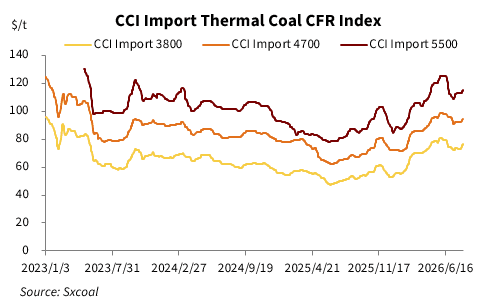
Domestic coal supply remained tight due to intensified mine safety inspections and heavy rain disrupting mining operations in some regions. Meanwhile, much of the country entered high-temperature mode, with power loads rising across eastern, central and northeastern China. Daily coal consumption at coastal power plants rose notably, with inventories depleting faster. In this context, coastal utilities and traders increased inquiries for imported coal.
As of August 9, coal inventories at six major coastal power groups stood at 14.19 million tonnes, down 1.25% from the previous week, while daily consumption rose 0.7% week on week. Stockpile availability stood at 15 days.
On the supply side, uncertainty over Indonesian RKAB quotas and Russian Black Sea logistics issues have slowed the arrival of some imported coal cargoes, further supporting Chinese buyers' inquiry interest for prompt and near-month shipments. However, total inventories at major domestic ports remain at elevated levels, and some participants remain cautious about import profit margins following consecutive price increases, suggesting near-term import pace may adjust.
India Indian thermal coal import demand remained subdued over the past week, with persistent rainfall curbing power consumption. Most buyers postponed purchases, with some focusing on lower-CV coal grades. Local traders maintained cautious stockpiling ahead of the monsoon's end.
Data from India's Central Electricity Authority (CEA) showed coal inventories at Indian power plants stood at 36.83 million tonnes as of August 9, down 6.09% from the previous week. Stockpile availability fell to 11.8 days, below the 12.1 days recorded a week earlier. On that day, 31 power plants were in critical low inventory status, unchanged from the previous week.
Meanwhile, weak steel prices and slow overall economic growth have also dampened the steel sector's demand for imported coal. The DRI sector, a key consumer of South African coal, has largely stayed away from the spot market recently, mainly due to weak domestic steel prices and relatively high imported coal costs. Some companies have increased domestic coal purchases or relied on inventories to maintain production.
Market participants generally expect Indian import demand to see a seasonal rebound as the monsoon ends in September and industrial activity recovers, with some traders already positioning in the forward market. However, the imported coal market is expected to continue its weak consolidation in the near term.
Europe European thermal coal prices remained firm. Natural gas prices fell as US-Iran tensions eased and geopolitical risk premiums faded, with TTF hub futures declining, somewhat undermining coal's economics in the power generation mix. As of late last week, European ARA ports 6,000 Kcal/kg NAR thermal coal CFR prices rose again from the previous week, approaching $120/t.
Dutch TTF natural gas prices fell notably last week. As of August 7, the ICE TTF benchmark Dutch gas September 2026 futures settled at 55.544 euros/MWh, down 5.97% from 59.071 euros/MWh a week earlier.
However, European logistics continue to face challenges. Water levels on the Rhine and Danube rivers have fallen to record lows, severely restricting inland barge traffic. Bulk cargoes including coal and chemicals cannot be delivered smoothly to inland power plants and industrial users, forcing some suppliers and utilities to turn to rail transport or alternative fuels to ease transport bottlenecks.
Although heatwaves in Germany and other regions lifted cooling-driven power demand and increased coal-fired generation, concurrent growth in renewable output limited further expansion of coal's share in the power mix. Additionally, nuclear plants in Hungary, Romania and Serbia reduced output due to cooling water restrictions, tightening regional power supply-demand balances, though this has yet to provide effective support to coal prices.
Sumber:
Artikel Lainnya
Liputan 6
Tayang pada
1,76 Juta Metrik Ton Batu Bara Disebar ke 4 PLTU Jaga Listrik di Jawa Tak Padam
Bisnis Indonesia
Tayang pada
10 dari 190 Izin Tambang yang Dibekukan Sudah Bayar Jaminan Reklamasi
Bisnis Indonesia
Tayang pada
10 Emiten Batu Bara dengan Laba Paling Jumbo Semester I/2026, AADI & BYAN Teratas
IDX Channel.com
Tayang pada
10 Emiten Batu Bara Paling Cuan di 2024, Siapa Saja?
METRO
Tayang pada