SXCOAL
Tayang pada
Monthly: Int'l thermal coal market sees divergent trends in Jul
The international thermal coal market in July showed a pattern of initial weakness followed by a recovery, with divergent trends across different regions.
In the first half of the month, the market continued the sluggish trend seen since June, with persistently weak demand from China and India, the two largest importers. High inventories and abundant hydropower output suppressed buying interest. The European market, after a brief rebound driven by high temperatures, declined again as temperatures fell and wind power generation surged, putting overall downward pressure on international coal prices.
Market sentiment improved significantly in the second half of the month. As geopolitical conflicts escalated again, risk premiums in the global energy market rose sharply. Oil and gas prices moved substantially higher, while freight and insurance costs increased in tandem, supporting an uptrend in international coal prices. At the same time, the onset of summer heatwaves in the Northern Hemisphere boosted cooling-related power demand in East Asia and Europe, raising daily consumption at power plants and improving the demand picture to some extent. However, actual spot market transactions remained constrained by high inventories and buyer price pressure, limiting the upside for prices.
1. Major Suppliers
1) Australia
The Australian thermal coal market fell first and then rose in July, with prices at the end of the month slightly lower than at the beginning. As of July 24, the price of 5,500 Kcal/kg NAR thermal coal at Australia's Newcastle port had fallen to below $94/t, down nearly $1/t from the end of June, a decline of 0.88%. The price bottomed out during the month at just above $90/t, hitting a new low since mid-April.
In the first half of the month, high-CV coal prices at Newcastle port continued to decline due to the absence of both Chinese and Indian buyers. In the second half, the sudden escalation of the Middle East situation pushed up freight rates and forward contract prices. Meanwhile, since late July, high temperatures in Northeast Asia, a key export destination for Australian coal, boosted power consumption expectations, leading to a rebound in Australian coal prices.
On the supply side, Australian miners' production was generally stable, unaffected by major weather or labor incidents. Some miners had sold out their prompt cargoes for July-August shipment and shifted to selling cargoes for September onwards, marginally tightening prompt supply.
With El Nino weather conditions gradually forming, market concerns grew over potential disruptions to Australian coal production and shipments around August, particularly mining operations and port loading in Queensland and New South Wales. If weather factors cause supply disruptions, combined with possible heatwaves in major Asian importing countries, the supply-demand balance could tighten temporarily.
2) Indonesia
The Indonesian Ministry of Energy and Mineral Resources' thermal coal reference prices for the first half of July all rose compared with the previous period, with most prices increasing in the second half. High-CV coal prices saw more significant gains. Details are as follows:
HBA: The reference price for high-grade 6,322 Kcal/kg coal (total moisture 12.26%, total sulfur 0.66%, ash 7.94%) was $126.58/t in the first half of July and $131.85/t in the second half, serving as the reference for coal with a calorific value of 6,100-6,500 Kcal/kg.
HBA I: The reference price for high-grade 5,300 Kcal/kg coal (total moisture 21.32%, total sulfur 0.75%, ash 6.04%) was $90.94/t in the first half of July and $89.9/t in the second half, serving as the reference for coal with a calorific value of 5,100-5,500 Kcal/kg.
HBA II: The reference price for high-grade 4,100 Kcal/kg coal (total moisture 35.73%, total sulfur 0.23%, ash 3.90%) was $62.59/t in the first half of July and $63.25/t in the second half, serving as the reference for coal with a calorific value of 3,900-4,300 Kcal/kg.
HBA III: The reference price for high-grade 3,400 Kcal/kg coal (total moisture 44.3%, total sulfur 0.24%, ash 3.88%) was $41.91/t in the first half of July and $45.08/t in the second half, serving as the reference for coal with a calorific value of 3,200-3,600 Kcal/kg.
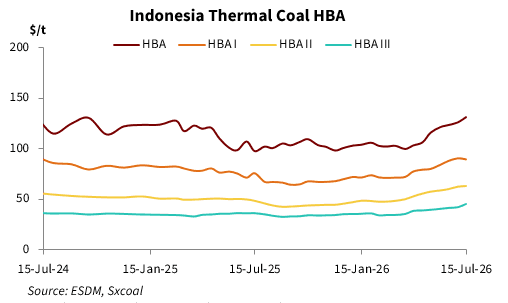
In July, the Indonesian coal market continued to be affected by policy uncertainties. The Indonesian government required miners to prioritize supply to domestic power plants. Coupled with occasional loading delays at some mining areas in Sumatra and Kalimantan due to rainfall, available cargoes in the export market tightened periodically.
Meanwhile, the industry continued to monitor the approval progress of miners' Work Plans and Budgets (RKAB) production quotas, which is expected to officially begin in August. However, the market expects that quotas will not increase significantly as previously anticipated, especially for export-oriented miners. Under this expectation, most miners prioritized allocating available cargoes to power plants operated by state-owned utility PLN, tightening supply of mid-CV coal in the seaborne market.
Additionally, in late July, the Indonesian government announced a one-stop export control system for key natural resource commodities through state-owned company Danantara Resources (DSI), with the effective date brought forward from the original January 2027 to September 1, 2026, to combat invoice under-reporting, false declarations, and transfer pricing. This news sparked widespread concern in the market, with both buyers and sellers adopting a wait-and-see approach, further suppressing spot liquidity.
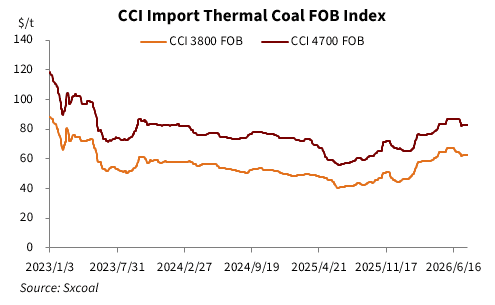
Indonesian thermal coal FOB prices fell slightly in July compared with the end of the previous month. Data from Sxcoal showed that as of July 30, the FOB price of Indonesian 3,800 Kcal/kg NAR coal was $62.5/t, down $2/t month on month; the FOB price of Indonesian 4,700 Kcal/kg NAR coal was $82.7/t, down $3.8/t month on month.
3) South Africa
The South African thermal coal market was generally weak in July, but saw a slight rebound near the end of the month driven by geopolitical factors. As of July 24, the price of South African 5,500 Kcal/kg NAR coal was up nearly $1/t from the previous month, but remained below $90/t, an increase of 0.95%.
During the month, Indian buyers were almost entirely absent from the South African coal spot market. Multiple factors, including monsoon rains suppressing power demand, ample and more competitively priced domestic coal supply, and the rupee's depreciation raising import costs, led core South African coal consumers such as Indian sponge iron producers to significantly reduce purchases and shift to domestic coal as their primary fuel source, using imported South African coal only for blending purposes.
On the supply side, South Africa's main coal export railway line experienced its third operational disruption since early June. Train services were suspended on July 15 due to social unrest before resuming. The annual maintenance of the northern corridor railway was carried out as scheduled from July 21 to August 1, causing short-term capacity disruptions.
Despite frequent logistics disruptions attracting market attention, inventory at the Richards Bay Coal Terminal remained at a relatively high level of around 5.1 million tonnes, staying above the 5-million-tonne mark for several consecutive weeks, reflecting that weak demand fully offset the impact of disruptions on the supply side.
South African customs data showed that in May 2026, South Africa's thermal coal (bituminous and sub-bituminous) exports totaled 5.82 million tonnes, down 8.11% year on year and 10.11% month on month. During the month, thermal coal exports from the Richards Bay Coal Terminal (RBCT) stood at 5.61 million tonnes, down 5.8% year on year and 9.74% month on month.
4) Russia
The Russian thermal coal market continued to face pressure in July. Due to weak buying interest from Chinese buyers, the price of 5,500 Kcal/kg NAR coal at Far East ports came under downward pressure, with a widening bid-ask spread making transactions difficult. The Baltic and Black Sea directions were relatively stable, with demand from Turkey maintaining some resilience.
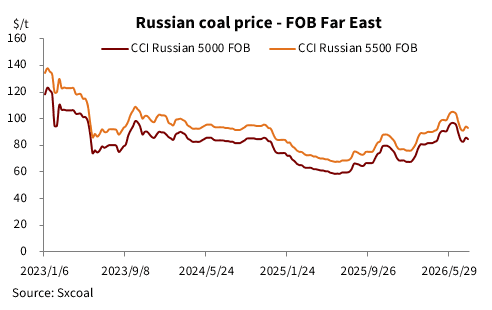
As of July 24, the CCI index for Russia 5,000 Kcal/kg NAR coal at Far East ports was assessed at $84.5/t FOB, down $4/t from the previous month; the CCI index for Russia 5,500 Kcal/kg NAR coal was assessed at $93/t FOB, down $4/t from the end of the previous month.
Some traders reported that most Russian suppliers had pre-sold their cargoes for the Baltic and Black Sea directions through September, making prompt spot supply relatively tight. However, this did not drive significant price increases, as downstream users such as cement plants were switching to more cost-effective petroleum coke.
Notably, the security situation in the Black Sea region deteriorated sharply in late July, with Ukraine using drones to attack Black Sea port infrastructure and passing vessels on multiple occasions, including a Turkish coal carrier. This incident heightened market concerns about potential disruptions to seaborne supply in the Black Sea region, adding new uncertainty to Russian coal exports to the Mediterranean region.
Kpler vessel tracking data showed that in June 2026, Russia's total seaborne coal exports reached 16.07 million tonnes, up 11.2% year on year and 7.86% month on month. The data showed that Russia exported 11.45 million tonnes of seaborne thermal coal during the month, up 7.31% year on year and 14.26% month on month.
2. Major Importers
1) China
China's import market remained subdued overall in July. High coal inventories at domestic power plants and ports, strong hydropower output, and sluggish growth in industrial power demand collectively suppressed coastal power plants' import purchasing interest.
In the first half of July, persistent rainfall in South China, combined with typhoon impacts in East China, kept daily coal consumption at coastal power plants well below seasonal levels. Meanwhile, many vessels were backlogged at South China ports, causing slow unloading, and end-users postponed purchases due to high on-site inventories.
In the second half of the month, as weather improved and temperatures rose, cooling loads boosted coal consumption. Some coastal power plants began releasing procurement demand for August shipment cargoes, increasing inquiries for Indonesian low-CV coal and Australian high-CV coal. At the same time, international LNG prices surged due to the Middle East situation, prompting some Chinese gas-fired power units to switch to coal-fired generation, further enhancing coal power's competitive advantage.
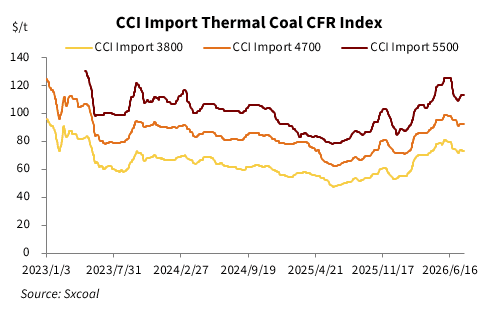
As of July 30, the CFR price of imported 3,800 Kcal/kg NAR coal at China's southern ports was $73.2/t, down $1.3/t from the end of June; the CFR price of imported 4,700 Kcal/kg NAR coal was $92.2/t, down $3.3/t from the end of the previous month; the CFR price of imported 5,500 Kcal/kg NAR coal was $113/t, up $0.5/t from the end of the previous month.
As of July 30, coal inventory at the six major coastal power groups stood at 14.47 million tonnes, down 0.62% from the end of June but up 3.94% year on year. Daily coal consumption at these plants was 934,000 tonnes, up 18.26% month on month and 5.88% year on year, with available stockpiles falling to 15.4 days.
However, overall, power plants' August demand was largely covered by long-term contracts and earlier imports, with some already starting to procure cargoes arriving in September. New spot demand releases were limited. Most market participants remained cautious, believing that price upside is limited before the end of summer, but a significant decline is unlikely in the near term.
At the end of July, the CFR price of imported 3,800 Kcal/kg NAR coal was 560.81 yuan/t, down 12.49 yuan/t from 573.3 yuan/t at the end of the previous month; the CFR price of imported 4,700 Kcal/kg NAR coal was 706.38 yuan/t, down 28.52 yuan/t from 734.9 yuan/t at the end of the previous month.
As of the end of July, the price advantage of imported 3,800 Kcal/kg NAR coal over domestic coal of the same quality was 9.42 yuan/t, compared with a disadvantage of 4.25 yuan/t at the end of the previous month. The price advantage of imported 4,700 Kcal/kg NAR coal was 38.84 yuan/t, significantly widening from 13.86 yuan/t a month earlier.
Customs data showed that in June, China's thermal coal (non-coking coal) imports totaled 30.6 million tonnes, up 27.86% from 23.93 million tonnes in the same period last year and up 38.32% from 22.12 million tonnes in May.
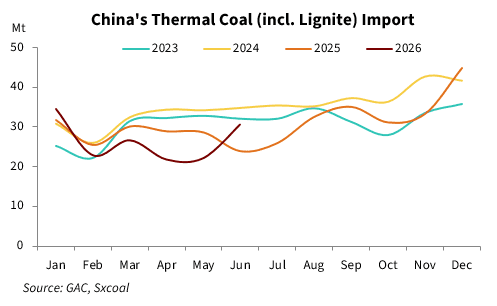
During the month, China's thermal coal import value was $2.48 billion, surging 60.48% year on year. This implies an average import price of $80.88/t for the month, up $16.44/t year on year.
2) Japan and South Korea
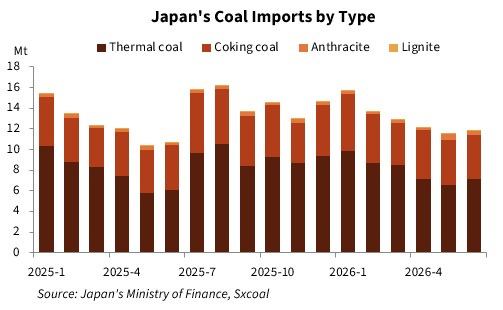
In June 2026, Japan's thermal coal (including other bituminous coal and other coal) imports totaled 7.15 million tonnes, up 18.55% year on year and 8.28% month on month. During the month, Japan imported 6.52 million tonnes of other bituminous coal, up 18.14% year on year and 8.56% month on month; imports of other coal stood at 631,800 tonnes, up 22.94% year on year and 5.54% month on month.
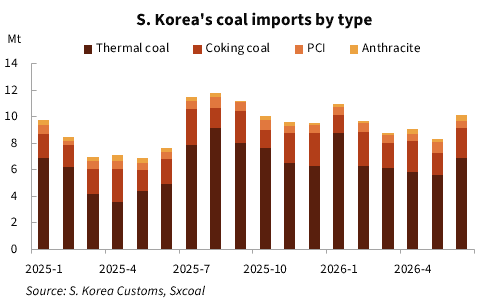
In June, South Korea's thermal coal (other bituminous coal and other coal) imports totaled 6.92 million tonnes, up 39.21% year on year and 23.77% month on month. During the month, South Korea imported 6.7 million tonnes of other bituminous coal, up 34.87% year on year and 24.65% month on month; imports of other coal stood at 215,400 tonnes, up 1.43% month on month, compared with almost zero imports in the same period last year.
3) India
Indian buyer demand remained persistently weak in July, becoming a key factor suppressing South African coal and Asia-Pacific seaborne coal prices. Widespread monsoon rains across central and northern India significantly reduced power consumption demand, with daily consumption at power plants weakening month on month.
Meanwhile, ample supply of relatively cheaper domestic coal provided a strong substitute for imported coal. High import coal costs, the rupee's depreciation, and improved domestic logistics collectively prompted end-users to switch to domestic coal, with the proportion of domestic coal used in sponge iron production rising sharply.
Data from India's Central Electricity Authority (CEA) showed that as of July 28, coal inventory at Indian power companies totaled 38.83 million tonnes, down 12.84% from the end of the previous month; available stockpiles stood at 12.4 days, down from 14.3 days at the end of June.
In late July, as geopolitical risks escalated and international coal prices rose, some Indian traders began to worry about subsequent arrival costs, locking in small volumes of September shipment coal, but mostly as tentative inquiries. Market participants generally expect Indian buyers to return to the import market in large numbers only after the monsoon season ends and port operations normalize, likely from late August to September.
Data from the Indian Ports Association (IPA) showed that in June 2026, India's 12 major state-run ports imported a total of 16.48 million tonnes of coal, down 0.68% year on year and 11.84% month on month. Among this, thermal coal imports totaled 11.37 million tonnes, down 2.35% year on year and 7.62% month on month.
The latest data from India's Central Electricity Authority showed that in June 2026, total coal imports by Indian power companies reached 4.69 million tonnes, down 7.89% year on year but up 14.96% month on month, hitting a new high in the past year. Of the coal imported by Indian power companies, 4.02 million tonnes were supplied to plants using imported coal directly, while 666,400 tonnes were used for blending with domestic coal.
Sumber:
Artikel Lainnya
Liputan 6
Tayang pada
1,76 Juta Metrik Ton Batu Bara Disebar ke 4 PLTU Jaga Listrik di Jawa Tak Padam
Bisnis Indonesia
Tayang pada
10 dari 190 Izin Tambang yang Dibekukan Sudah Bayar Jaminan Reklamasi
Bisnis Indonesia
Tayang pada
10 Emiten Batu Bara dengan Laba Paling Jumbo Semester I/2026, AADI & BYAN Teratas
IDX Channel.com
Tayang pada
10 Emiten Batu Bara Paling Cuan di 2024, Siapa Saja?
METRO
Tayang pada