SXCOAL
Tayang pada
Weekly: Int'l thermal coal market shows mixed trends, high-CV coal firm
International thermal coal markets showed mixed trends over the past week, with high-CV coal prices firming while medium- and low-CV grades weakened.
Geopolitical risks, including the collapse of US-Iran peace talks, attacks on vessels in the Black Sea, and Houthi threats to Saudi facilities in the Red Sea, pushed up risk premiums across global energy markets. Supply-side disruptions — from Indonesia's sudden export policy shift to near-stalled Russian Black Sea shipments and volatile South African rail performance — added further pressure.
Despite mounting supply-side disruptions, coal price gains remained capped by a lack of demand-side support, with prices largely fluctuating within ranges. Chinese buyers focused on essential procurement only, India stayed on the sidelines due to monsoon season, and European spot trade remained thin despite summer heat support. Most participants adopted a wait-and-see approach, seeking clearer signals.
Supply
Indonesia Uncertainty deepened in Indonesia's coal market over the past week. Miners continued submitting work plans and budgets (RKAB) to the government, with most awaiting approval processes expected to start in August. Elevated freight rates and the government's announcement to bring forward the effective date of a unified coal export system added to market caution.
As of late last week, offers for Indonesian 3,800 Kcal/kg NAR Panamax coal stood at $64/t FOB, with some deals concluded at $63/t, market participants said. Freight for Panamax vessels from South Kalimantan to southern China ports was at $9.5/t.
As of July 24, the CCI index for Indonesian 3,800 Kcal/kg NAR coal was assessed at $62.5/t FOB, flat from a week earlier but down $2.5/t from a month ago. The CCI index for 4,700 Kcal/kg NAR coal stood at $82.7/t FOB, down $0.3/t week on week and $4.3/t lower than a month earlier.
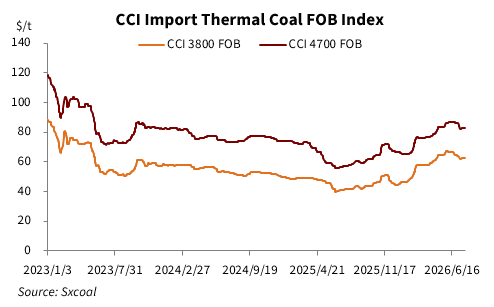
Early last week, the Indonesian government announced it would bring forward the effective date of a one-stop export policy for key natural resource commodities, to be implemented through state-owned PT Danantara Resources (DSI), to September 1, 2026 — earlier than the original January 2027 plan. The policy shift sparked widespread concern among market participants.
Meanwhile, miners remained focused on the approval progress of annual production quotas. The market expects quotas may not increase as previously anticipated, particularly for export-oriented miners, with approvals expected to begin in August. Against this backdrop, most miners prioritized allocating available cargo to power plants operated by state utility PT PLN, tightening export market supply and lifting spot premiums. Some mining areas in Sumatra and Kalimantan experienced loading delays due to rainfall, though overall production was not significantly affected.
Russia High-CV thermal coal prices at Russia's Far East ports edged up last week, while prices at southern and northern ports held steady. However, rising freight costs continued to pressure FOB offers.
As of July 24, the CCI index for Russian 5,000 Kcal/kg NAR coal at Far East ports was assessed at $84.5/t FOB, down $1/t from a week earlier and $10.5/t lower than a month ago. The CCI index for Russian 5,500 Kcal/kg NAR coal stood at $93/t FOB, also down $1/t week on week and $10.5/t lower month on month.
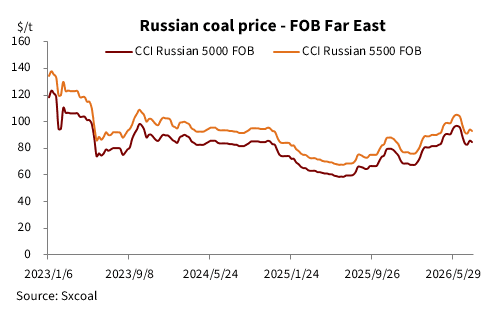
Tensions in the Middle East supported high-CV coal prices in Asian and European markets, while hot weather in Northeast Asia slightly boosted market activity. Asian markets continued to show some procurement demand for Russian and Australian coal, but weak buying interest from Chinese buyers limited sustained upward support for Russian coal offers.
Russian coal exports via the Baltic Sea remained relatively stable, though European sanctions and insurance restrictions continued to divert flows mainly toward Asia. The Black Sea disruption further intensified competition from non-Russian coal in the Mediterranean region.
Australia Australian high-CV thermal coal prices performed strongly over the past week, driven by increased procurement from Chinese power plants and demand for LNG substitution in Northeast Asian markets. As of July 24, Newcastle port 5,500 Kcal/kg NAR coal prices fell below $94/t, down about $0.5/t week on week, while 6,000 Kcal/kg NAR coal prices rose slightly to above $133/t.
Australian supply remained broadly stable, with no major weather or labor disruptions affecting miner operations. However, increased inquiries from Chinese buyers strengthened miners' willingness to hold firm offers, particularly for 5,500 Kcal/kg NAR high-ash coal. Some miners had sold out prompt cargoes for July-August loading and shifted to selling September-loading cargoes. Despite the uptick in Chinese buying interest, actual transactions did not expand significantly due to high port inventories in China, with a notable gap between buyer and seller price expectations.
South Africa South Africa's thermal coal market held firm over the past week, also supported by geopolitical factors, with prices posting modest gains. However, demand-side fundamentals remained weak.
As of July 24, the price for South African 5,500 Kcal/kg NAR coal at Richards Bay rose to above $89/t FOB, up nearly $1/t from a week earlier and slightly lower than a month ago. Meanwhile, the price for 6,000 Kcal/kg NAR coal rose nearly $2/t week on week to above $106/t.
Rail performance to the Richards Bay Coal Terminal (RBCT) improved, though weekly rail volume fell 8% week on week to 1.23 million tonnes, still above the year-to-date weekly average of 1.17 million tonnes. Terminal inventory stood at around 5.1 million tonnes, staying above the 5-million-tonne mark for a second consecutive week.
However, exporters reported subdued loading demand at the Dry Bulk Terminal (DBT) and Multi-Purpose Terminal (MPT), mainly due to the absence of Indian buyers. South African miners generally held firm offers, hoping that geopolitical risks would further boost the futures market and trigger concentrated buying. Actual spot offers remained scarce, with buyers and sellers in a standoff.
Demand
China China's imported thermal coal market weakened over the past week. Low end-user loads and high inventories at ports and power plants limited restocking demand to essential procurement only, with overall transactions remaining in a stalemate amid buyer price-cutting efforts.
As of July 24, the CCI index for import 3,800 Kcal/kg NAR coal at China southern ports was assessed at $73.2/t CFR, down $0.3/t from a week earlier. The CCI index for import 4,700 Kcal/kg NAR coal stood at $92.2/t CFR, also down $0.3/t week on week. The CCI index for import 5,500 Kcal/kg NAR coal was at $113/t CFR, up $1/t from a week earlier.
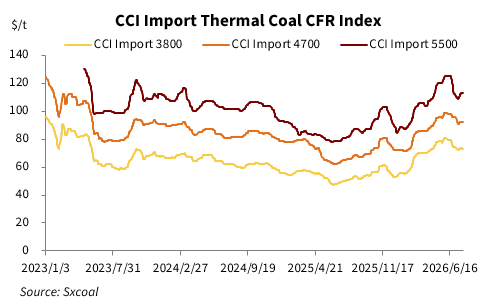
Early in the week, heavy rainfall and typhoon weather disrupted unloading at southeastern ports and inland transport. Combined with persistently high inventories at major ports, power utilities were in no rush to restock, mainly issuing tenders on an as-needed basis with a clear price-cutting stance. As of July 26, coal inventory at the six major coastal power groups stood at 14.44 million tonnes, down 0.5% from a week earlier, with days of coal consumption falling to around 16 days.
As weather improved later in the week, rising temperatures in coastal and inland areas boosted cooling demand and coal consumption. Some coastal power plants began releasing procurement demand for August-loading cargoes, increasing inquiries for Indonesian low-CV and Australian high-CV coal. Meanwhile, surging international LNG prices due to Middle East tensions prompted some Chinese gas-fired power units to switch to coal-fired generation, further improving coal's economics.
India Heavy monsoon rainfall across India disrupted port operations and mine-mouth transport in many regions. The rains also reduced cooling electricity demand, with coal consumption at power plants weakening month on month.
Data from the Central Electricity Authority (CEA) showed that as of July 26, coal inventory at Indian power plants stood at 39.22 million tonnes, down 4.4% from a week earlier. Days of coal consumption fell to 12.6 days, compared with 13.2 days a week earlier. On the same day, 29 power plants were in critically low inventory, up by three from a week earlier.
Despite notable inventory drawdowns at power plants over the past week, overall supply pressure was not severe enough to trigger emergency procurement. Import buyers remained almost entirely on the sidelines, with only sporadic inquiries for South African and Indonesian medium-CV coal. Only a few direct reduced iron (DRI) plants made limited price inquiries due to production continuity needs, but actual transactions were limited.
Meanwhile, India's domestic coal supply continued to improve, with stable production, enhanced rail transport efficiency, and a clear price advantage for domestic coal, further curbing import appetite. However, toward the weekend, as geopolitical risks escalated and international coal prices rose, some Indian traders began to worry about future arrival costs, locking in limited volumes of September-loading cargoes, though mostly buyers stayed selective and continued to constrain aggressive purchasing.
Europe European thermal coal forward prices strengthened over the week. Weather forecasts indicated above-average temperatures across the continent in the coming week, which is expected to boost cooling demand and power loads, providing fundamental support for coal prices. As of late last week, the price for 6,000 Kcal/kg NAR coal at ARA ports fell below $119/t CIF, down nearly $1/t from a week earlier.
TTF natural gas futures surged to a four-month high due to Middle East conflict and low gas storage levels, further widening the marginal cost advantage of coal-fired power over gas-fired power. Coal-fired power plant operating hours in Germany and other countries increased.
Last week, Dutch TTF natural gas prices surged. As of July 24, the ICE TTF benchmark Dutch gas futures for August 2026 delivery closed at 63.575 euros/MWh, up 10.77% from 57.395 euros/MWh a week earlier.
However, spot market trading remained very subdued. Coal inventory at ARA ports increased by 12.8% week on week to 4.23 million tonnes. Persistently low Rhine River water levels severely restricted barge transport capacity from ports to inland power plants, limiting the actual coal available to plants and keeping them from increasing spot purchases. Additionally, while there were inquiries for high-CV coal from Colombia and the US, firm seller offers and a gap with buyer price expectations resulted in very few actual transactions.
Sumber:
Artikel Lainnya
Liputan 6
Tayang pada
1,76 Juta Metrik Ton Batu Bara Disebar ke 4 PLTU Jaga Listrik di Jawa Tak Padam
Bisnis Indonesia
Tayang pada
10 dari 190 Izin Tambang yang Dibekukan Sudah Bayar Jaminan Reklamasi
IDX Channel.com
Tayang pada
10 Emiten Batu Bara Paling Cuan di 2024, Siapa Saja?
METRO
Tayang pada
10 Negara Pengguna Bahan Bakar Fosil Terbesar di Dunia
CNBC Indonesia
Tayang pada