SX Coal
Tayang pada
Weekly: China's coastal coal freight rates hit new high before retreating
China's coastal coal freight rates smashed a new high since mid-March 2022 last week, before experiencing the first decline since early February due to weakening of shipping demand.
The China Coastal Coal Freight Composite index, which tracks rates for vessels carrying coal from northern China ports to ports in the east and south, increased 8.48% from the week before to 1,098 points on March 27, according to the Shanghai Shipping Exchange. It surged 79.76% compared to month-ago levels and 40.18% from a year ago.
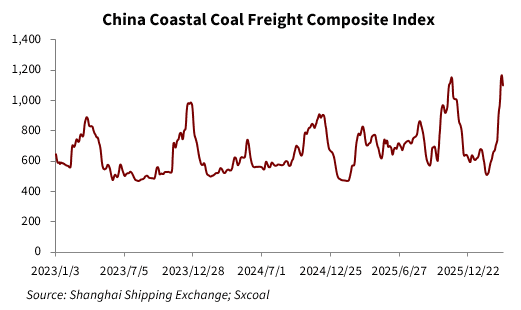
Early last week, northern ports experienced stock congestion due to continued high rail coal arrivals, leading some to restrict further deliveries. Traders sought to offload cargoes, boosting vessel demand. Meanwhile, elevated imported coal prices encouraged some power utilities to purchase domestic supplies, further supporting shipping activity.
Rising global oil prices encouraged vessel owners to hold firm offers amid bullish sentiment. Weather-related port closures also limited vessel turnover, tightening shipping capacity. Against this backdrop, freight rates extended the uptrend early last week.
However, rising domestic coal prices and freight rates discouraged end users from accepting high-priced cargoes. Coupled with improved cost advantage of imported coal and offseason demand, domestic purchases subdued. Meanwhile, retreats in global freight rates weakened cost support, reducing vessel owners' willingness to maintain firm offers.
By late last week, freight rates edged slightly lower, though still posted a marked week-on-week gain as a whole.
During the week, most shipping routes rose 2.1-6.0 yuan/t compared to week-ago levels. The freight rate for the 50,000-60,000 DWT vessels carrying coal from Qinhuangdao to Guangzhou port increased 3.0 yuan/t week on week to 65 yuan/t on March 27, while that for 60,000-70,000 DWT vessels on the same route grew 2.1 yuan/t from a week ago to 62 yuan/t.

Internationally, the Baltic Dry Index (BDI), tracking rates for ships carrying dry bulk commodities, stood at 2,036 points on March 27, down 0.97% compared to 2,056 points a week ago.
Amid soft demand and ample supply, Panamax vessels from Indonesia to China stood at $9.80/t on March 27, falling $0.61/t from the previous week, while Supramax freight rates on the route reached $12.11/t, retreating $0.34/t compared to a week earlier. Meanwhile, Capesize vessels from Australia to China declined $0.82/t week on week to $18.55/t.
Looking ahead, freight rates are unlikely to repeat recent gains as the offseason deepens, though some supportive factors remain in place.
Sumber:
Artikel Lainnya
Liputan 6
Tayang pada
1,76 Juta Metrik Ton Batu Bara Disebar ke 4 PLTU Jaga Listrik di Jawa Tak Padam
Bisnis Indonesia
Tayang pada
10 dari 190 Izin Tambang yang Dibekukan Sudah Bayar Jaminan Reklamasi
IDX Channel.com
Tayang pada
10 Emiten Batu Bara Paling Cuan di 2024, Siapa Saja?
METRO
Tayang pada
10 Negara Pengguna Bahan Bakar Fosil Terbesar di Dunia
CNBC Indonesia
Tayang pada