SXCOAL
Tayang pada
Monthly: China May thermal coal prices rebound as stalemate broken by mine accident
China's domestic thermal coal prices gradually drifted higher in May after a stalemate in early and mid-month amid a rough supply-demand balance. A fatal mine accident in late May led to large-scale safety scrutiny and disrupted supplies. This, combined with decent demand releases, drove a price rally.
April supply-demand summary
Supply China's total thermal coal supply stood at 323.64 million tonnes in April, falling 14.88% month on month. Cumulative supply in January-April stood at 1.37 billion tonnes, down 0.71% year on year.
Demand Thermal coal consumption totaled 312.75 million tonnes in April, down 14.66% from a month earlier. Demand over January-April reached 1.39 billion tonnes, increasing 3.25% on the year.
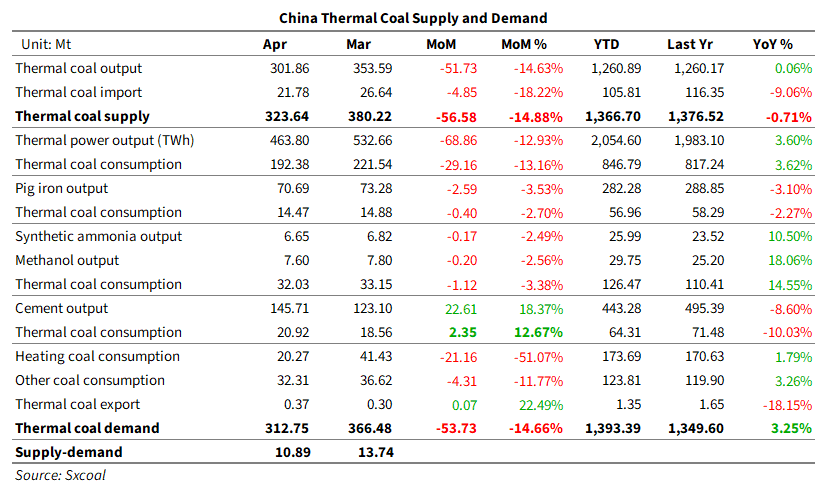
Overall, the market recorded a supply surplus of 10.89 million tonnes in April, lower than the 13.74 million tonnes in March.
Production areas
In early-to-mid May, operations at thermal coal mines across major producing regions remained largely stable and at high utilization rates, barring isolated maintenance or longwall moves. However, coal sales moderated amid difficulties in securing rail wagon approvals and a seasonal lull in demand from the non-power sector.
A gas explosion at a coal mine in Shanxi's Changzhi triggered a wave of safety inspections and self-imposed shutdowns across the province and beyond. Speculative traders sent more trucks to coal mines, combined with the bullish portside market, spurring broader price growth.
On the supply side, aside from select mines undergoing longwall moves, most ran normally in the first half. Some producers completed monthly tasks by the month-end. This, together with accident-induced production suspensions and reductions, constrained overall supply. Sxcoal's tracking data showed the average weekly output of surveyed mines in the month to March 22 stood at 16.75 million tonnes, down 0.3% month on month and 0.9% on the year.
As the portside market stabilized in early May, some traders adopted a wait-and-see sentiment. Yet, with the summer peak season approaching, long-term contract offtakes by power plants improved, and chemical plants made steady purchases to cover essential needs. Overall mine inventories stayed at medium-to-low levels. Month-end supply tightened further following the Shanxi coal mine accident. Railway station-based traders shipped coal actively, and end users consistently placed orders. Power plants focused on fulfilling long-term coal contracts, thereby increasing truck loadings and boosting inventory drawdowns at mines.
As of April 27, stocks at Sxcoal-surveyed mines stood at 3.92 million tonnes, down 1.2% from a month earlier and 11.9% lower year on year.
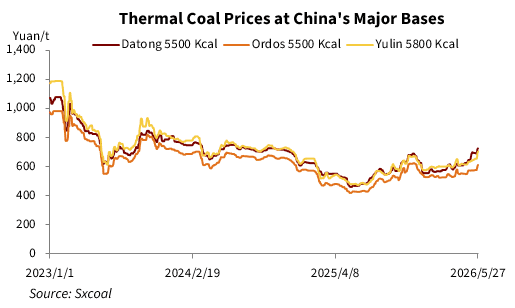
As of May 28, Shanxi Datong 5,500 Kcal/kg NAR thermal coal was assessed at 725 yuan/t, mine-mouth with VAT, rising 90 yuan/t from a month earlier. Inner Mongolia Ordos 5,500 Kcal/kg NAR coal was at 609 yuan/t, advancing 50 yuan/t from the month before, and Shaanxi Yulin 5,800 Kcal/kg NAR thermal coal was assessed at 702 yuan/t, rising 57 yuan/t month on month.
Transfer ports
Coal inventories at northern transfer ports piled up in May. On the inbound side, daily transport capacity recovered to a fully loaded status of 1.3 million tonnes and above after the Daqin railway maintenance, correspondingly increasing inflows at Qinhuangdao port. Meanwhile, rail shipments under the CR Hohhot Group also returned to high levels, notably boosting coal arrivals at northern ports.
However, affected by freight rate adjustments and increased transport volumes for other cargo types, main rail routes experienced varying degrees of unsmooth wagon approvals, limiting stockpile growth at ports.
In terms of outflows, end users presented improved buying enthusiasm approaching peak summer months, driving up overall outbound volumes. Yet, coal outflows were still slightly lower than inflows. Consequently, portside inventories rose but remained below year-ago levels.
As of May 28, total inventories at major northern ports stood at 28.46 million tonnes, up 8.8% month on month yet down 9.3% year on year. Qinhuangdao port stocks reached 6.90 million tonnes, gaining 25.0% from a month earlier and 0.7% on the year.
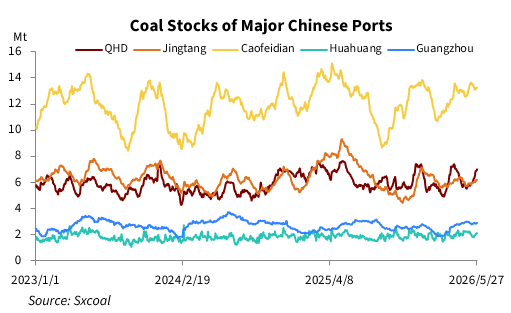
Coal consumption at power plants in southern China hovered high. Guangdong province pushed local coal-fired power plants to ensure fuel stocks to cover no less than 20 days of usage, and any plant whose available days fall below 15 days shall be dynamically cleared. Generators hence actively secured cargoes. Bolstered by bullish summer expectations, Guangdong port inventories stood at 2.88 million tonnes as of May 27, down 3.1% on the month yet up 2.6% on the year.
As a result, domestic thermal coal prices initially stagnated last month due to subdued demand and increased inventories against decent summer demand anticipations. Supply restrictions by the month-end subsequently pushed up coal prices.
As of May 28, 5,500 Kcal/kg NAR thermal coal traded at Qinhuangdao port reached 849 yuan/t, FOB with VAT, rising 41 yuan/t from the month before.
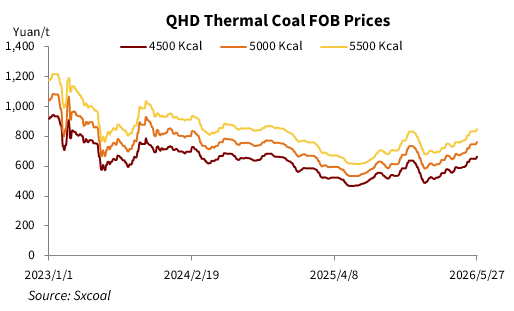
At southern China's Guangzhou port, Shanxi premium mixed 5,500 Kcal/kg NAR coal with 0.6% sulfur gained 15 yuan/t month on month to 910 yuan/t, ex-stock with VAT. Power plant consumption in southern China performed well alongside hot weather. Given insufficient import supplements as well as rising prices at northern ports, domestic coal prices likewise edged up.
Import market
Indonesia, constrained by DMO and RKAB approvals, saw tight export cargo availability, underpinning forward prices. Based on costs and peak-season expectations, importers continuously raised bid prices to end users. Yet coal burns at power plants had not yet reached peak levels, combined with relatively safe inventories, dampening generators' acceptance of high-priced cargoes.
Available days of fuel stocks at coastal power plants were not high. Power plants restarted restocking as temperatures rose. Chinese coal supplies are expected to diminish further due to the mine accident. Most participants believed that the growth in imported coal prices is expected to surpass that of domestic coal by the month-end.
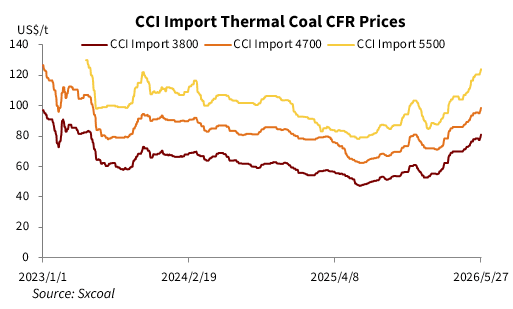
As of May 28, the CCI index for imported 5,500 Kcal/kg, 4,700 Kcal/kg, and 3,800 Kcal/kg NAR coal stood at $124.0/t, $98.5/t, and $81.0/t CFR, respectively, rising $11.0/t, $6.5/t, and $5.7/t from a month ago.
Consuming areas
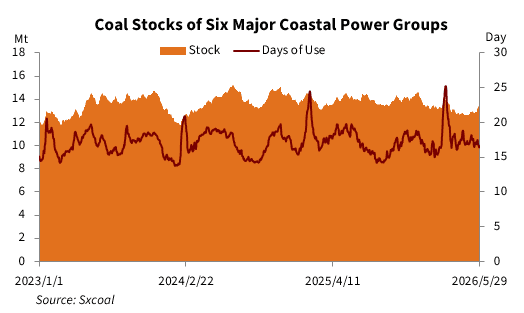
In early May, coastal areas experienced frequent rainfall, capping residential electricity demand. Coal inventories at power plants continued to accumulate, given sustained intakes based on long-term contracts. Phased high temperatures in late May boosted coal burns at plants. Despite consistently climbing inventories, available days declined to relatively low levels.
As of May 28, stocks at power plants under six major coastal power groups stood at 13.48 million tonnes, up 6.77% from end-April yet down 4.09% year on year. Daily consumption was 816,000 tonnes, up 9.09% month on month and 4.88% year on year. Days of inventory stood at 16.5 days, 0.4 day lower than a month earlier and also down 1.5 days on the year.
May highlights recap
At about 19:29 on May 22, a gas explosion occurred underground at the Liushenyu coal mine of Shanxi Tongzhou Group in Qinyuan county, Changzhi city, Shanxi province. The accident resulted in 82 deaths, 2 missing miners, and 128 injuries. It was the most severe accident to occur in China's coal industry in nearly two decades.
Following the accident, a series of industry-wide reverberations were triggered. The accident-stricken Shanxi province ushered in a new round of inspections for hidden danger, leading to mine shutdowns across multiple regions. This then spread to surrounding provinces. Subsequently, a nationwide impact was generated with the issuance of an urgent notice on further strengthening coal mine gas prevention and control work.
At the same time, as temperatures rose and the summer peak season approached, energy supply assurance was formally arranged at the national level. On May 28, the National Development and Reform Commission required that all regions and relevant enterprises fully recognize the importance of the task of summer peak energy supply assurance, closely monitor key areas and critical periods, and make every effort to ensure safe and stable operations of energy supply during the summer peak.
In addition, the upcoming June marks China's 25th safety month. The launch ceremony was held in Beijing on May 28. Zhang Guoqing, vice premier of the State Council, stressed that all regions and departments must deeply learn the lessons of the accident, rigorously implement workplace safety responsibility and ensure safety management measures are put in place.
Each month, Sxcoal's analyst team conducts a comprehensive analysis of China's thermal coal market from the perspectives of supply/demand, import/export, stock, and price trends. The monthly report also includes insights on the latest coal policies, key events, and forecasts for thermal coal prices for the upcoming month and the remainder of the year.
Prior to the end of each month, Sxcoal publishes the China Thermal Coal Market Monthly Analysis and Forecast.
Sumber:
Artikel Lainnya
Liputan 6
Tayang pada
1,76 Juta Metrik Ton Batu Bara Disebar ke 4 PLTU Jaga Listrik di Jawa Tak Padam
Bisnis Indonesia
Tayang pada
10 dari 190 Izin Tambang yang Dibekukan Sudah Bayar Jaminan Reklamasi
IDX Channel.com
Tayang pada
10 Emiten Batu Bara Paling Cuan di 2024, Siapa Saja?
METRO
Tayang pada
10 Negara Pengguna Bahan Bakar Fosil Terbesar di Dunia
CNBC Indonesia
Tayang pada