SXCOAL
Tayang pada
India Mar coal imports rise 8.67% MoM on steel sector demand
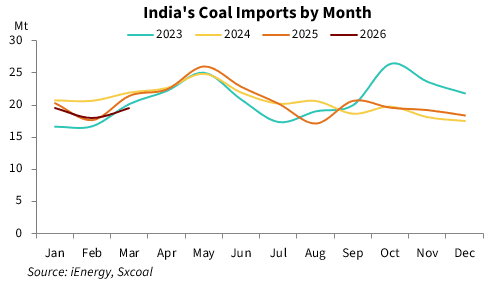
India's coal imports rebounded in March 2026 from the month prior, underpinned by increased demand from the steel industry, although volumes were lower compared with a year earlier against a backdrop of growing uncertainty in the global economy and evolving geopolitical tensions.
The country imported 19.60 million tonnes of coal in March, down 8.54% year on year (YoY) but up 8.67% month on month (MoM), according to data from iEnergy.
During March, the global economy remained sluggish while the Middle East conflict continued to push energy prices higher, amplifying inflationary pressures across regions. Financial market volatility intensified and bond yields rose.
India's domestic economic growth momentum softened slightly, while the crude oil price surge triggered by Middle East tensions propelled import bills, inflation and the current account deficit higher, prompting the government to lower its GDP growth forecast for the fiscal year 2026-27 to 6.7%.
Coal output and supply remained robust as FY26 drew to a close. Coal production surpassed 1 billion tonnes for the second consecutive year in March, reaching 113.7 million tonnes, down 4% YoY but up 13% MoM. Coal dispatches totaled 90.8 million tonnes, down 15% YoY and flat MoM.
India's thermal coal market showed divergent trends in March. Early in the month, prices firmed on tight global supply, heightened geopolitical tensions and firm offers from producers. However, high inventories and elevated seaborne freight rates kept Indian buyers cautious, with imports largely limited to immediate requirements and no significant stockpiling ahead of the summer.
Cumulative coal imports stood at 57.24 million tonnes in the first three months of 2026, down 3.61% from 59.38 million tonnes in the same period a year earlier.
In breakdown by type, the South Asian nation imported 12.73 million tonnes of non-coking coal in March, down 16.16% YoY yet up 7.5% MoM, accounting for nearly 65% of total coal imports. Coking coal imports reached 5.03 million tonnes, up 15.16% YoY and 13.06% MoM, making up 25.65% of the total.
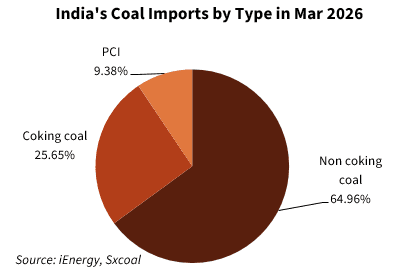
Over January-March, non-coking coal imports amounted to 37.20 million tonnes, down 7.64% YoY, reflecting subdued import appetite amid moderate industrial activity and relatively sufficient power plant inventories. Coking coal imports climbed 6.54% YoY to 14.33 million tonnes, driven by seasonal steel demand.
Imports of PCI coal totaled 1.84 million tonnes in March, up 10.48% YoY and 20.82% MoM, while no anthracite was imported.
India imported 522,100 tonnes of met coke in March, surging 59.83% YoY but sliding 15.72% MoM, while petroleum coke imports slumped 31.21% YoY but rose 27.89% MoM to 775,200 tonnes.
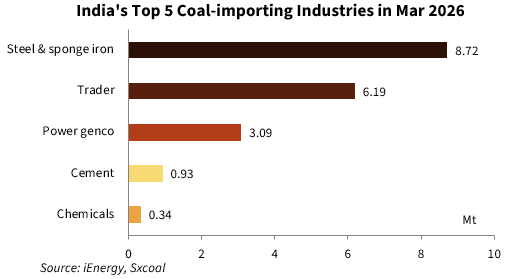
India's steel and sponge iron industries imported most coal in March at 8.72 million tonnes, up 15.73% YoY and 24.32% MoM, as per iEnergy data.
India's steel sector demonstrated strong growth momentum, propelled by rising domestic demand and trade dynamics. Finished steel consumption grew 8% YoY in FY26, reflecting vigorous activity in infrastructure, construction and manufacturing. Despite global uncertainties, sustained domestic demand cemented India's position as a net steel exporter, underpinning continued growth in coking coal demand.
In March, India's power sector imported 3.09 million tonnes of coal, tumbling 50.19% YoY and down 18.46% MoM. India's power demand hit 149 TWh in the month, the highest for that period in over a decade and slightly above 147 TWh a year earlier. The mild YoY increase was largely because rainfall was 10% above normal levels, reducing cooling demand. A high base a year ago and slowing manufacturing activity also weighed on power consumption.
Nonetheless, power demand is still projected to post a significant rise this fiscal year, with growth estimated at 5.5-6.5%, driven by factors including potentially higher temperatures from El Nino, robust economic activity and a low base effect.
The cement sector imported 931,900 tonnes, diving 23.46% YoY and 5.08% MoM; and the chemical industry received 335,400 tonnes, plunging 46.64% YoY and 39.15% MoM.
By origin, Indonesia remained India's largest coal supplier in March, shipping 7.08 million tonnes, down 33.98% YoY and 7.26% MoM. Australian coal arrivals gained 34.82% YoY and 25.55% MoM to 3.61 million tonnes.
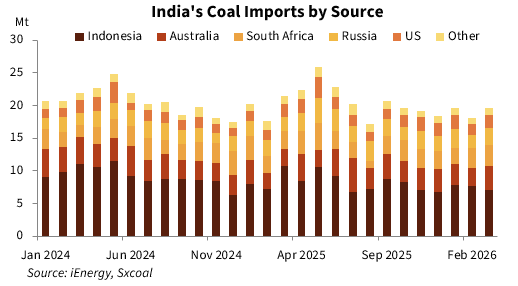
Imports from South Africa rose 24.04% YoY and 10.89% MoM to 3.27 million tonnes, and Russian coal imports increased 17.68% YoY and 34.23% MoM to 2.64 million tonnes. Coal intakes from the U.S. declined 2.31% YoY but grew 14.14% MoM to 1.91 million tonnes.
Looking ahead, restocking demand from power plants could see marginal improvement as the summer peak season approaches, but high domestic production and ample inventories are likely to cap any rebound in thermal coal imports. Sustained strength in the steel sector will continue to support coking coal and PCI coal demand, though global steel trade frictions and raw material cost swings may squeeze steel mills' margins.
Non-power sectors, such as cement, constrained by limited cost pass-through ability, could further reduce consumption of high-priced petroleum coke.
On the supply side, geopolitical risks remain the biggest variable. Any escalation in the Middle East would push up international oil prices and freight rates, indirectly lifting coal landed costs. Exchange rate fluctuations of the Indian rupee and the trajectory of domestic monetary policy will also influence importers' purchasing appetite.
Sumber:
Artikel Lainnya
Liputan 6
Tayang pada
1,76 Juta Metrik Ton Batu Bara Disebar ke 4 PLTU Jaga Listrik di Jawa Tak Padam
Bisnis Indonesia
Tayang pada
10 dari 190 Izin Tambang yang Dibekukan Sudah Bayar Jaminan Reklamasi
Bisnis Indonesia
Tayang pada
10 Emiten Batu Bara dengan Laba Paling Jumbo Semester I/2026, AADI & BYAN Teratas
IDX Channel.com
Tayang pada
10 Emiten Batu Bara Paling Cuan di 2024, Siapa Saja?
METRO
Tayang pada