SX Coal
Tayang pada
China's power plants defy seasonal norms with resilient coal burn
China's domestic participants anticipated the onset of the traditional off-season for thermal coal demand entering March 2026. However, recent resilient coal consumption at power plants defied the seasonal lull.
Coal burns at power plants climbed steadily in March, Sxcoal data showed, notably higher than the average level during the corresponding period. Delayed post-Chinese New Year industrial activity, robust power demand from emerging sectors and unfavorable weather for renewables kept coal-fired units running at elevated levels.
As of March 25, daily coal consumption at power plants under six major coastal power groups reached 787,600 tonnes, rising 124,800 tonnes from the beginning of the month and 13,200 tonnes higher than the same period last year. The volume was also up 35,800 tonnes from March 25, 2024.
This trend was even more pronounced at major plants across eight coastal provinces, where daily coal burns reached 1.99 million tonnes on March 25, jumping 270,000 tonnes from early March. The figure even peaked at 2.12 million tonnes during the month, a level considerably above the sub-2-million-tonne mark for this time of year.
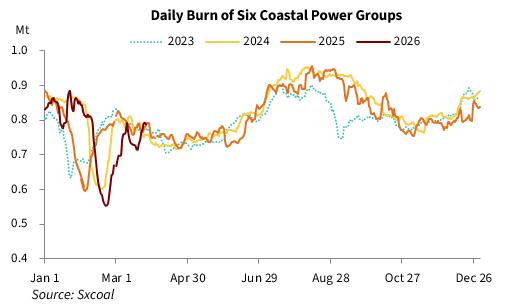
Several factors explained why power plant consumption did not exhibit a typical lull.
While it is March on the calendar, the Chinese lunar calendar has only just entered the second month, meaning the Chinese New Year period has just concluded. Industrial activity usually resumes gradually after the Lantern Festival, which falls on the 15th day of the first lunar month, and largely normalizes by the end of that month. This gradual return to full operations pushed steady increases in coal usage at power plants.
Meanwhile, the late arrival of the Spring Festival this year created a notable discrepancy compared with previous years. In most years, the seasonal retreat in thermal coal demand is already evident by March, but this year that pattern failed to materialize. The lower year-ago base also contributed to high year-on-year growth in power plant coal consumption.
Moreover, robust growth in electricity consumption from emerging industries expanded the market for coal-fired power. Rapid expansion in sectors such as new energy vehicles, lithium batteries, photovoltaics, and artificial intelligence significantly increased power demand, boosting power loads and consequently increasing the utilization of thermal power.
Geopolitical tensions in the Middle East pushed up global energy prices, spurring surging electricity prices in countries such as Japan. This indirectly influenced expectations in China's domestic power market, prompting some regions to ramp up thermal power generation in advance to ensure supply stability.
On the policy front, ongoing reforms in the electricity market are also affecting coal-fired power utilization. Since March 1, 2026, several regions have abolished fixed time-of-use electricity pricing in favor of rates that more closely reflect real-time supply and demand. This change would encourage some energy-intensive enterprises to adjust production schedules, contributing to temporary peaks in power demand.
In addition, persistent overcast and rainy weather in parts of southern China curbed renewable energy output. Given the declined solar power generation, thermal power was called upon to fill the gap, further boosting coal consumption.
Amid rising consumption and sustained essential buys, coal inventories at power plants reduced notably. As of March 25, coal stocks at plants under six major coastal power groups totaled 12.74 million tonnes, falling 971,000 tonnes from early March and 794,000 tonnes lower than the same period last year.
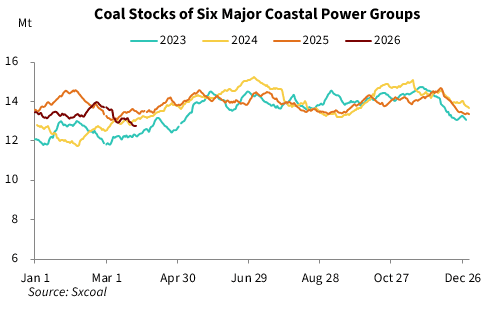
Nevertheless, as the lull season is expected to take hold soon and long-term contract supplies remain stable, power plants were in no rush to secure large-volume cargoes. Only some coastal power plants stepped up purchases of certain cost-effective domestic resources.
However, the pricing advantage of domestic coal against imported equivalents eased considerably amid consistently climbing domestic prices. Certain overseas cargoes even approached parity with domestic coal. Imported coal may soon resume its role as a supplement to the domestic supply.
Also, signs of potential talks between the U.S. and Iran have emerged. Should such diplomatic efforts materialize, the logic underpinning elevated coal prices, driven by high oil prices, could weaken.
If power plants continue to draw down fuel inventories while coal stocks at northern China ports keep building, the current uptrend in portside thermal coal prices may draw to a close.
Sumber:
Artikel Lainnya
Liputan 6
Tayang pada
1,76 Juta Metrik Ton Batu Bara Disebar ke 4 PLTU Jaga Listrik di Jawa Tak Padam
Bisnis Indonesia
Tayang pada
10 dari 190 Izin Tambang yang Dibekukan Sudah Bayar Jaminan Reklamasi
Bisnis Indonesia
Tayang pada
10 Emiten Batu Bara dengan Laba Paling Jumbo Semester I/2026, AADI & BYAN Teratas
IDX Channel.com
Tayang pada
10 Emiten Batu Bara Paling Cuan di 2024, Siapa Saja?
METRO
Tayang pada