SXCOAL
Tayang pada
China May coal imports fall YoY, narrow decline from Apr
China's coal imports continued their year-on-year decline in May, albeit at a much slower rate than in April, with a slight month-on-month increase driven by pre-summer restocking and domestic supply disruptions.
Customs data showed May coal imports stood at 33.27 million tonnes, down 7.7% year on year but up 0.55% from the previous month. The annual decline narrowed by 4.84 percentage points from April's drop.
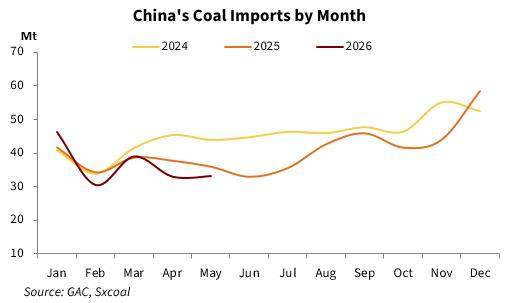
The year-on-year fall was widely expected, as tight import supply, high freight and transport costs, ample domestic supply and healthy power plant inventories reduced reliance on expensive seaborne coal.
However, a surge in overland imports, particularly from Mongolia, partially offset the decline in seaborne shipments, helping narrow the annual contraction.
The modest month-on-month increase was largely seasonal, as rising temperatures and surging grid loads across southern China lifted thermal coal consumption at coal-fired power plants, prompting restocking at coastal utilities.
A coal mine accident in Shanxi also triggered tighter safety inspections, raising supply concerns among some end users, especially in southern China, and accelerating procurement as import economics improved temporarily.
Market sources said structural inventory imbalances at some power plants and steel mills, particularly the latter, led to increased import tenders for certain coal grades in the short term.
The month-on-month improvement in May imports was largely driven by seasonal restocking and short-term adjustments following domestic supply disruptions, rather than a sustained recovery, with volumes still constrained by supply and cost factors.
Indonesia's new policy on single-window coal exports had no material impact on China's May imports. Supply remained tight, keeping imports subdued, though long-term contract deliveries stayed stable, maintaining overall volumes at a certain level.
The market has partially priced in Indonesia's supply risks, but customs clearance and shipping data lag, meaning the new policy had no direct impact on May arrivals. Its effects may gradually emerge after June.
Overall, during the transition period of Indonesia's new export policy, buyer and seller concerns may temporarily boost Indonesian coal arrivals. The real cost increases and structural contraction are expected after full implementation in September.
Looking ahead, coal imports are likely to continue falling year on year, though month-on-month gains may persist as peak summer demand emerges, albeit at a limited pace.
Sumber:
Artikel Lainnya
Liputan 6
Tayang pada
1,76 Juta Metrik Ton Batu Bara Disebar ke 4 PLTU Jaga Listrik di Jawa Tak Padam
Bisnis Indonesia
Tayang pada
10 dari 190 Izin Tambang yang Dibekukan Sudah Bayar Jaminan Reklamasi
IDX Channel.com
Tayang pada
10 Emiten Batu Bara Paling Cuan di 2024, Siapa Saja?
METRO
Tayang pada
10 Negara Pengguna Bahan Bakar Fosil Terbesar di Dunia
CNBC Indonesia
Tayang pada